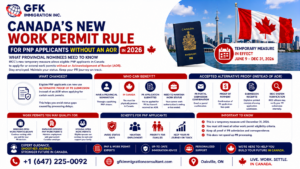
Canada’s New Work Permit Rule for PNP Applicants Without an AOR in 2026: What Provincial Nominees Need to Know
Canada has introduced a significant temporary immigration measure that could provide relief to thousands of Provincial Nominee Program (PNP) applicants waiting for their permanent residence applications to move forward.
As of June 2026, certain eligible PNP applicants can now apply for or extend work permits without first receiving an Acknowledgement of Receipt (AOR) from Immigration, Refugees and Citizenship Canada (IRCC). This policy change is designed to help foreign workers maintain legal status and continue working while facing lengthy permanent residence processing delays.
At GFK Immigration Inc., we understand how stressful immigration processing delays can be. This guide explains the new rule, who qualifies, what documents are required, and how this temporary measure could affect your pathway to Canadian permanent residence.
What Is an Acknowledgement of Receipt (AOR)?
An AOR is an official confirmation from IRCC indicating that a permanent residence application has been received and passed the initial completeness review.
Traditionally, many PNP applicants needed an AOR before becoming eligible for certain work permit categories, including Bridging Open Work Permits (BOWPs) and some employer-specific work permit extensions.
However, growing delays in issuing AORs have left many applicants at risk of losing their work authorization while waiting for permanent residence processing to continue.
What Changed in June 2026?
Effective June 9, 2026, IRCC introduced temporary operational measures allowing eligible in-Canada Provincial Nominee Program applicants to use alternative proof of permanent residence submission instead of an AOR when applying for certain work permits. The policy is currently scheduled to remain in effect until December 31, 2026.
The objective is straightforward:
- Prevent status gaps for skilled workers.
- Help employers retain workers.
- Reduce disruptions caused by prolonged AOR processing delays.
- Support provincial labour market needs.
Why Did IRCC Introduce This New Rule?
According to immigration updates and operational guidance, IRCC has experienced delays in conducting completeness checks on permanent residence applications, resulting in slower issuance of AORs. Some applicants have waited months longer than expected before receiving confirmation that their PR application was accepted into processing.
Without an AOR, many provincial nominees were unable to access certain work permit options and risked:
- Losing legal work status.
- Interrupting employment.
- Facing financial hardship.
- Experiencing delays in their immigration plans.
The temporary policy addresses this gap.
Who Can Benefit From the New Work Permit Rule?
The temporary measures may benefit eligible individuals who:
Have a Provincial Nomination
Applicants must have received a qualifying provincial nomination through a Provincial Nominee Program.
Are Physically Present in Canada
The temporary measure primarily applies to applicants already residing in Canada.
Have Submitted a Permanent Residence Application
Applicants must have already submitted their PR application even if they have not yet received an AOR.
Need to Maintain Work Authorization
The policy is intended for applicants whose work authorization may expire before their permanent residence application progresses.
What Alternative Proof Can Applicants Use Instead of an AOR?
Under the temporary measures, applicants may be able to provide alternative evidence demonstrating that their permanent residence application has been submitted.
Examples may include:
- PR portal submission confirmation emails.
- Proof of payment of permanent residence application fees.
- Submission receipts.
- System-generated application confirmation records.
IRCC officers may verify application status directly through internal systems when reviewing work permit requests.
Are Spouses Included?
Yes.
One of the most important aspects of the new policy is that eligible spouses of certain PNP applicants may also benefit from expanded access to open work permits. This can provide additional financial stability for families while permanent residence applications are being processed.
Which Work Permit Categories Are Affected?
The temporary measures may apply to several work permit scenarios, including:
Bridging Open Work Permits (BOWPs)
Eligible PNP applicants awaiting permanent residence decisions may benefit from alternative proof requirements.
Employer-Specific PNP Work Permits
Certain provincial nominees seeking employer-specific work permits may also qualify under the temporary policy.
Spousal Open Work Permits
Eligible spouses may continue accessing work permit opportunities without unnecessary delays.
What Does This Mean for PNP Applicants?
This change offers several practical benefits.
Reduced Risk of Losing Work Status
Applicants can continue working legally while waiting for permanent residence processing.
Greater Employment Stability
Workers and employers gain more certainty during lengthy processing periods.
Better Family Support
Spouses may maintain employment authorization, helping families remain financially secure.
Improved Immigration Planning
Applicants can continue building Canadian work experience while pursuing permanent residence.
Frequently Asked Questions
Do I still need an AOR eventually?
Yes. The temporary measure only addresses delays in receiving an AOR. If IRCC later issues an AOR, applicants should retain it as part of their immigration records.
Is this policy permanent?
No. As of June 2026, the measure is temporary and is expected to remain in place until December 31, 2026, unless extended or modified by IRCC.
Can applicants outside Canada use this policy?
Current guidance primarily focuses on eligible applicants who are already inside Canada.
Does this change affect Express Entry applicants?
The temporary measure specifically targets certain Provincial Nominee Program applicants impacted by AOR delays. Eligibility should be reviewed carefully based on the applicant’s immigration stream.
Will this speed up permanent residence processing?
No. The policy does not accelerate PR processing. It simply allows eligible applicants to maintain work authorization while waiting for their applications to be processed.
How GFK Immigration Inc. Can Help
Navigating Canada’s work permit and permanent residence rules can be complex, especially when temporary policy changes are introduced.
At GFK Immigration Inc., we help clients:
- Assess PNP eligibility.
- Apply for work permits and extensions.
- Prepare permanent residence applications.
- Navigate Express Entry and Provincial Nominee Programs.
- Respond to IRCC requests.
- Develop long-term immigration strategies.
Our team closely monitors IRCC policy updates to help clients make informed decisions and avoid unnecessary delays.
Final Thoughts
Canada’s new temporary work permit policy for Provincial Nominee Program applicants is welcome news for workers and families affected by AOR processing delays.
By allowing alternative proof of PR submission, IRCC is helping eligible provincial nominees maintain legal status, continue working, and reduce uncertainty while waiting for permanent residence decisions.
If you are a PNP applicant waiting for an Acknowledgement of Receipt, this temporary measure could provide an important opportunity to protect your status and employment in Canada.
Need Help With Your PNP Application or Work Permit?
GFK Immigration Inc.
📞 +1 (647) 225-0092
🌐 gfkimmigrationconsultant.com
📍 Oakville, Ontario, Canada
Disclaimer
This article is provided for educational and informational purposes only and does not constitute legal or immigration advice. Immigration policies, eligibility criteria, and temporary public measures may change without notice. Always consult official Government of Canada resources or a licensed Canadian immigration professional regarding your specific circumstances.