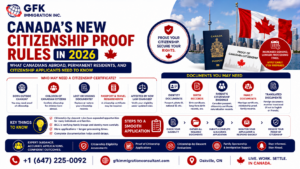
Canada’s New Citizenship Proof Rules in 2026: What Canadians Abroad, Permanent Residents, and Citizenship Applicants Need to Know
Canada’s citizenship landscape continues to evolve in 2026, particularly following recent discussions and legislative changes surrounding citizenship by descent. As a result, many individuals are asking an important question:
How can I prove that I am a Canadian citizen?
Whether you were born abroad to Canadian parents, recently became a citizen, or are applying for proof of citizenship, understanding Canada’s updated citizenship proof requirements is essential.
At GFK Immigration Inc., we regularly assist clients with citizenship-related matters and help families navigate complex citizenship eligibility and documentation requirements. This guide explains the latest citizenship proof rules in 2026, who may be affected, and how applicants can avoid costly delays.
What Is Proof of Canadian Citizenship?
Canada’s New Citizenship Proof Rules in 2026
A Proof of Citizenship certificate—commonly called a citizenship certificate—is an official document issued by Immigration, Refugees and Citizenship Canada (IRCC) confirming that an individual is a Canadian citizen.
Unlike a Canadian passport, a citizenship certificate serves as formal evidence of citizenship status.
You may need a citizenship certificate if:
- You were born outside Canada to a Canadian parent.
- You acquired citizenship automatically through descent.
- You lost your citizenship documents.
- You need proof of citizenship for a passport application.
- You are confirming eligibility following recent citizenship law changes.
- You are applying for benefits or services that require citizenship verification.
Why Are Citizenship Proof Applications Increasing in 2026?
Demand for citizenship certificates has grown significantly due to ongoing reforms involving citizenship by descent.
Recent legal developments have expanded opportunities for some individuals born outside Canada to claim Canadian citizenship through their parents or grandparents.
As a result, thousands of people worldwide are now reviewing their family history to determine whether they qualify for Canadian citizenship.
This increased demand has contributed to longer processing times for citizenship proof applications and record searches.
Who Needs a Citizenship Certificate?
Canada’s New Citizenship Proof Rules in 2026
Many people mistakenly assume that a Canadian passport is the only acceptable proof of citizenship.
However, certain situations specifically require a citizenship certificate.
Individuals Born Outside Canada
If you were born abroad and believe you inherited Canadian citizenship through a parent, you may need a citizenship certificate to formally establish your status.
Children of Canadian Citizens
Many parents apply for citizenship certificates on behalf of children born outside Canada to confirm citizenship eligibility.
Lost or Damaged Documents
If previous citizenship records are unavailable, applicants may need replacement certificates.
Individuals Affected by Citizenship-by-Descent Changes
Recent policy changes have encouraged many Canadians abroad to verify their citizenship status through official documentation.
What Documents Are Required to Prove Canadian Citizenship?
Canada’s New Citizenship Proof Rules in 2026
The exact requirements vary depending on individual circumstances, but applicants are commonly asked to provide:
Identity Documents
Examples include:
- Valid passport
- Government-issued photo identification
- National identity card
Birth Records
Applicants may need:
- Birth certificates
- Long-form birth records
- Foreign civil registration documents
Parent’s Citizenship Evidence
Canada’s New Citizenship Proof Rules in 2026
Where citizenship is claimed through a parent, supporting documents may include:
- Canadian birth certificate
- Citizenship certificate
- Canadian passport records
- Naturalization records
Supporting Family Documentation
Additional records may be required to establish family relationships and lineage.
Providing complete documentation at the time of application can help reduce processing delays.
New Areas of Focus in 2026
While Canada’s citizenship proof process remains largely familiar, several developments have increased scrutiny in certain areas.
Family Lineage Verification
Applications involving citizenship by descent often require detailed evidence connecting applicants to Canadian citizen parents or grandparents.
Identity Confirmation
IRCC continues strengthening identity verification measures to protect the integrity of Canada’s citizenship system.
Historical Citizenship Records
Older cases may require searches of archived government records, which can increase processing times.
International Documentation
Foreign-issued civil documents must often meet translation and certification requirements before being accepted.
How Long Does a Citizenship Proof Application Take in 2026?
Canada’s New Citizenship Proof Rules in 2026
Processing times fluctuate based on application volume and complexity.
In 2026, citizenship certificate applications have experienced longer processing periods due to increased demand and expanded eligibility reviews.
Factors affecting processing times include:
- Missing documentation
- Requests for additional evidence
- Historical record searches
- Complex citizenship-by-descent claims
- High application volumes
Applicants should prepare for extended timelines and avoid making travel or employment decisions based solely on anticipated approval dates.
Common Mistakes That Cause Delays
Many citizenship proof applications experience delays because of avoidable errors.
Incomplete Family Documentation
Missing parental or grandparental records can slow verification.
Untranslated Foreign Documents
Documents not submitted in the required format may result in additional requests.
Incorrect Application Information
Discrepancies between records can trigger further review.
Missing Identity Documents
Applicants should ensure all identification requirements are satisfied before submission.
Waiting Too Long to Apply
Individuals who may qualify under evolving citizenship rules should seek guidance and begin gathering documentation as early as possible.
What Does This Mean for Permanent Residents?
Canada’s New Citizenship Proof Rules in 2026
For most permanent residents pursuing Canadian citizenship through naturalization, these citizenship proof changes do not directly affect the standard citizenship application process.
However, understanding citizenship documentation remains important because:
- Citizenship certificates may be required after approval.
- Family members abroad may qualify through descent.
- Future citizenship legislation could affect family eligibility.
Permanent residents should continue focusing on meeting current citizenship requirements, including physical presence, language proficiency, and tax obligations.
Frequently Asked Questions
Is a Canadian passport proof of citizenship?
A Canadian passport is generally accepted as evidence of citizenship. However, some situations specifically require a citizenship certificate issued by IRCC.
Who should apply for proof of citizenship?
Individuals born outside Canada to Canadian parents, those replacing lost citizenship records, and people seeking confirmation of citizenship eligibility may need to apply.
Have citizenship proof rules changed in 2026?
The application process remains largely the same, but increased attention to citizenship-by-descent eligibility and identity verification has increased demand for citizenship certificates.
How can I avoid delays?
Submit complete documentation, ensure all foreign documents are properly translated, and provide clear evidence supporting citizenship claims.
Does a citizenship certificate expire?
No. Citizenship certificates generally do not expire, although individuals should protect and preserve the document carefully.
How GFK Immigration Inc. Can Help
Canada’s New Citizenship Proof Rules in 2026
Citizenship-by-descent cases and citizenship proof applications can be more complex than many applicants realize.
At GFK Immigration Inc., we assist clients with:
- Citizenship eligibility assessments
- Proof of citizenship applications
- Citizenship-by-descent evaluations
- Permanent residence pathways
- Family sponsorship applications
- Visitor visas, work permits, and study permits
- Immigration strategy consultations
Our team stays informed about the latest citizenship developments to help families make informed decisions.
Final Thoughts
Canada’s New Citizenship Proof Rules in 2026
Canada’s citizenship proof process has become increasingly important in 2026 as more individuals explore their eligibility through Canadian parents and family connections.
While the core application requirements remain familiar, increased demand and evolving citizenship-by-descent rules have made proper preparation more important than ever.
If you believe you may qualify for Canadian citizenship or need official proof of your status, gathering the right documents early and seeking professional guidance can help avoid unnecessary delays and complications.
Need Help Confirming Your Canadian Citizenship Status?
GFK Immigration Inc.
📞 +1 (647) 225-0092
🌐 gfkimmigrationconsultant.com
📍 Oakville, Ontario, Canada
Disclaimer
This article is provided for educational and informational purposes only and does not constitute legal or immigration advice. Citizenship laws, eligibility requirements, and processing times may change. Individuals should consult official Government of Canada resources or a licensed Canadian immigration professional regarding their specific circumstances.
#CanadianCitizenship #ProofOfCitizenship #CanadaImmigration #CitizenshipCertificate #CanadianPassport #IRCC #CanadaPR #CitizenshipByDescent #ImmigrateToCanada #CanadianCitizenship2026 #ImmigrationNews #GFKImmigration