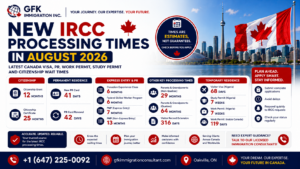
New IRCC Processing Times in August 2026: Latest Canada Visa, PR, Work Permit, Study Permit and Citizenship Wait Times
Last Updated: August 12, 2026
Immigration, Refugees and Citizenship Canada (IRCC) has released its latest processing-time updates for August 2026, giving applicants a clearer picture of how long different Canadian immigration and citizenship applications may take.
The latest figures show a mixed picture.
Some economic immigration programs are showing signs of improvement. The Federal Skilled Worker Program (FSWP) has dropped to an estimated six months, while the Canadian Experience Class (CEC) remains at six months.
However, several other categories are experiencing significant delays. The most notable increase is for Canadian citizenship certificates, where the estimated processing time has reached 25 months.
Temporary-residence applications are also moving in different directions. For example, a visitor visa application from Nigeria is currently estimated at 68 days, while a work permit application from Nigeria is estimated at 7 weeks. Meanwhile, visitor record extensions have surged to 316 days.
For anyone planning to visit, study, work, immigrate to or remain in Canada, understanding these changes is important for making realistic travel, employment and immigration plans.
Important: IRCC processing times are estimates, not guarantees. Your actual processing time can be shorter or longer depending on your application, completeness, background checks, verification requirements and IRCC’s workload.
What Are the Latest IRCC Processing Times in August 2026?
IRCC uses its processing-time tool to provide estimates for different immigration, citizenship and temporary-residence applications.
The latest August 2026 figures can be grouped into two broad update cycles:
- Monthly updates: citizenship, permanent residence and family sponsorship categories.
- Weekly updates: visitor visas, study permits, work permits and permanent resident cards.
The monthly figures were updated on August 10, 2026, while the temporary-residence and PR-card figures referenced in this update are from August 5, 2026.
Because IRCC regularly updates its processing-time tool, applicants should always verify the current estimate before making important travel or immigration decisions.
IRCC Processing Times: Key Changes in August 2026
Here are some of the most important developments applicants should know about.
| Application Category | August 2026 Estimated Processing Time |
|---|---|
| Citizenship grant | 12 months |
| Citizenship certificate | 25 months |
| New PR card | 41 days |
| PR card renewal | 42 days |
| CEC | 6 months |
| Federal Skilled Worker Program | 6 months |
| Express Entry PNP | 7 months |
| Non-Express Entry PNP | 13 months |
| Quebec Skilled Worker | 11 months |
| Parents & Grandparents Sponsorship – non-Quebec | 29 months |
| Parents & Grandparents Sponsorship – Quebec | 64 months |
| Visitor record extension | 316 days |
| Work permit from inside Canada | 119 days |
| Study permit extension | 70 days |
These figures represent the latest available estimates at the time of publication and can change as IRCC receives and processes applications.
1. Canadian Citizenship Processing Times
Citizenship processing continues to be one of the most closely watched areas in the August update.
Citizenship Grant: 12 Months
The estimated processing time for a Canadian citizenship grant remains at approximately 12 months.
The citizenship grant is the process used by eligible permanent residents who are applying to become Canadian citizens.
Citizenship Certificate: 25 Months
The biggest increase in the citizenship category involves applications for a Canadian citizenship certificate, which has reached approximately 25 months.
This represents a substantial increase from previous months.
Applicants who need proof of Canadian citizenship should therefore plan carefully, particularly if they require the certificate for travel, documentation or another immigration-related purpose.
Other Citizenship Applications
The August figures include:
- Resumption of citizenship: Not enough data
- Renunciation of citizenship: 4 months
- Search of citizenship records: 17 months
The citizenship certificate backlog deserves particular attention because the queue has expanded considerably.
2. Permanent Resident Card Processing Times
For permanent residents who are waiting for or renewing their PR cards, the August 5 update shows relatively stable processing times.
New PR Card
Estimated processing time:
41 days
PR Card Renewal
Estimated processing time:
42 days
For permanent residents planning international travel, it is important to remember that having permanent resident status and having a valid PR card are not exactly the same thing.
Applicants should avoid leaving PR-card applications until the last minute if upcoming international travel is planned.
3. Express Entry and Permanent Residence Processing Times
Economic immigration continues to show some positive movement.
Canadian Experience Class — 6 Months
The Canadian Experience Class (CEC) remains at approximately:
6 months
The CEC is designed primarily for skilled workers who have qualifying Canadian work experience and meet the program requirements.
Federal Skilled Worker Program — 6 Months
The Federal Skilled Worker Program (FSWP) has improved to:
6 months
This represents a one-month improvement compared with the previous estimate.
However, applicants should not interpret the six-month estimate as a guarantee that every application will be finalized within six months.
Provincial Nominee Program Through Express Entry — 7 Months
The estimated processing time for PNP applications processed through Express Entry remains:
7 months
Non-Express Entry PNP — 13 Months
For Provincial Nominee Program applications outside Express Entry, the current estimate is:
13 months
This illustrates why candidates should understand the differences between Express Entry-linked provincial nominations and base/non-Express Entry pathways before choosing an immigration strategy.
4. Family Sponsorship Processing Times
Family reunification remains an important part of Canada’s immigration system, but processing times vary significantly depending on the category and whether the sponsor will live in Quebec.
Spouse or Common-Law Partner Outside Canada
For applications involving a spouse or common-law partner living outside Canada:
- Outside Quebec: 17 months
- Quebec: 33 months
Spouse or Common-Law Partner Inside Canada
For inland applications:
- Outside Quebec: 27 months
- Quebec: 32 months
Parents and Grandparents Sponsorship
The August estimates are:
- Outside Quebec: 29 months
- Quebec: 64 months
The large difference between Quebec and other provinces reflects the additional immigration responsibilities created by the Canada–Quebec Accord.
Families should therefore avoid assuming that a processing time shown for one province applies everywhere in Canada.
5. Visitor Visa Processing Times in August 2026
Temporary-residence processing times are updated more frequently than many permanent-residence categories.
For visitor visa applications submitted from outside Canada, the August 5 estimates include:
| Country | Visitor Visa Processing Time |
|---|---|
| India | 27 days |
| United States | 21 days |
| Nigeria | 68 days |
| Pakistan | 48 days |
| Philippines | 16 days |
What Does This Mean for Nigerian Applicants?
For applicants applying for a Canadian visitor visa from Nigeria, the current estimated processing time is:
68 days
This is five days longer than the previous July 23 estimate.
Nigerian applicants planning to visit Canada should therefore avoid making travel arrangements based on an assumption that a visa will be issued within a few weeks.
A complete application, strong supporting evidence and realistic travel planning remain essential.
6. Visitor Record Extension Processing Time Surges
One of the most significant changes in the August update involves visitor record extensions.
The estimated processing time has increased to:
316 days
That is more than ten months.
The increase represents a substantial jump from the previous update.
Foreign nationals already in Canada as visitors who need to extend their authorized stay should therefore assess their options well before their current status expires.
Applicants should also understand the rules surrounding maintained status and ensure that any extension application is submitted correctly and on time.
7. Super Visa Processing Times
The latest Super Visa estimates vary significantly by country.
| Country | Super Visa Processing Time |
|---|---|
| India | 56 days |
| United States | 126 days |
| Nigeria | 43 days |
| Pakistan | 185 days |
| Philippines | 100 days |
Super Visa Processing Time for Nigerians
For applicants from Nigeria, the current estimate is:
43 days
This is four days higher than the previous update.
Families planning for parents or grandparents to visit Canada under the Super Visa program should still apply early because processing estimates can change.
8. Study Permit Processing Times
International students should also pay close attention to the latest figures.
For applications submitted outside Canada:
| Country | Study Permit Processing Time |
|---|---|
| India | 5 weeks |
| United States | 5 weeks |
| Nigeria | 7 weeks |
| Pakistan | 7 weeks |
| Philippines | 5 weeks |
Study Permit Processing Time for Nigerians
The current estimate for applicants from Nigeria is:
7 weeks
This is two weeks longer than the January 2026 figure and two weeks higher than the previous July update.
Students should therefore submit their applications as early as possible, particularly if they have a fixed program start date.
Study Permit Extensions
For applicants already in Canada, study permit extensions are currently estimated at:
70 days
Students should monitor their permit expiry dates carefully rather than waiting until the final weeks before applying.
9. Work Permit Processing Times
Work permit processing times also vary according to where the applicant is applying from.
Applications Outside Canada
| Country | Work Permit Processing Time |
|---|---|
| India | 9 weeks |
| United States | 3 weeks |
| Nigeria | 7 weeks |
| Pakistan | 25 weeks |
| Philippines | 6 weeks |
Work Permit Processing Time for Nigerians
For applicants from Nigeria, the latest estimate is:
7 weeks
This represents a one-week increase from the previous update.
Work Permit Applications From Inside Canada
The estimated processing time for initial and extension work permit applications submitted from inside Canada has improved to:
119 days
This is one of the more positive developments in the latest processing-time update.
10. Pakistan Work Permit Processing Time Sees a Major Increase
One of the largest country-specific changes is for work permit applications from Pakistan.
The estimate has increased to:
25 weeks
This is a substantial increase from the previous update.
Applicants should not assume that the processing time for one country will apply to another. IRCC processing can vary based on application volumes, processing offices, verification requirements and other operational factors.
11. Seasonal Agricultural Worker Program and IEC
Other temporary work-related categories have also changed.
Seasonal Agricultural Worker Program
Current estimated processing time:
71 days
International Experience Canada
Current estimated processing time:
7 weeks
These estimates can change as IRCC processes new applications and adjusts its operational capacity.
12. Electronic Travel Authorization (eTA)
For most eligible travellers, an eTA application can be processed very quickly.
In many cases, approval arrives within minutes.
However, applicants selected for additional review may need to wait longer, potentially up to 72 hours.
Travellers should therefore apply for an eTA before their flight rather than waiting until they arrive at the airport.
Why Are IRCC Processing Times Changing?
IRCC processing times are not fixed deadlines.
The department considers several factors when calculating or updating processing estimates, including:
- The number of applications in the inventory
- The number of applications expected to arrive
- Available processing capacity
- Application completeness
- How easily information can be verified
- Security and background checks
- Program-specific priorities
- Immigration levels and annual admission targets
- The complexity of individual applications
IRCC explains that some processing times are forward-looking estimates, while others are based on historical processing data.
For certain applications, historical processing times are based on how long it took IRCC to process approximately 80% of applications in a previous period.
Does an IRCC Processing Time Guarantee a Decision by That Date?
No.
An IRCC processing time is an estimate, not a guaranteed deadline.
Two applicants applying under the same program can receive decisions at different times.
An application may take longer if:
- Documents are missing
- IRCC requests additional information
- Background checks are still underway
- Security screening is required
- Medical examinations need additional review
- Family circumstances change
- The application is considered complex
- IRCC receives an unexpected increase in applications
Applicants should therefore use processing times for planning purposes rather than treating them as guaranteed decision dates.
What Can Applicants Do to Avoid Immigration Processing Delays?
Although applicants cannot control IRCC’s workload, they can reduce avoidable delays by preparing carefully.
1. Submit a Complete Application
Missing documents can result in delays, additional document requests or, in some circumstances, refusal.
Review the applicable document checklist carefully before submitting.
2. Provide Accurate Information
Your forms, supporting documents and personal history should be consistent and truthful.
Discrepancies can lead to additional questions or verification.
3. Respond Quickly to IRCC Requests
If IRCC requests additional documents, medical examinations, biometrics or other information, respond within the specified deadline.
4. Keep Your Contact Information Updated
Applicants should ensure IRCC has their current:
- Email address
- Mailing address
- Telephone number
- Passport information where applicable
5. Monitor Your IRCC Account
Important messages and document requests may be sent through your online account.
Checking regularly can help you avoid missing a deadline.
6. Apply Early
If you need a study permit, work permit, visitor visa, Super Visa or status extension, avoid waiting until the last possible moment.
What the August 2026 IRCC Processing-Time Update Means for Nigerians
For Nigerians planning to travel, study, work or immigrate to Canada, several figures deserve special attention.
Current August estimates for Nigerian applicants include:
- Visitor visa: 68 days
- Super Visa: 43 days
- Study permit: 7 weeks
- Work permit: 7 weeks
These figures can change with future IRCC updates.
For Nigerian applicants, early preparation is particularly important when travel dates, school start dates or employment timelines are fixed.
What This Means for Canada Immigration Applicants in 2026
The August 2026 update demonstrates that Canada’s immigration processing system is moving at different speeds depending on the program.
There are encouraging signs in economic immigration, including the FSWP improvement to six months and a smaller CEC inventory.
At the same time, major delays remain in areas such as citizenship certificates and visitor record extensions.
The key lesson for applicants is simple:
Don’t plan your immigration journey around a single processing-time number.
Instead, consider your eligibility, application quality, expected processing time, document requirements and personal timeline together.
Frequently Asked Questions About IRCC Processing Times in August 2026
What is the current IRCC processing time for Express Entry in August 2026?
The August 2026 estimates are approximately 6 months for the Canadian Experience Class (CEC) and 6 months for the Federal Skilled Worker Program (FSWP). Express Entry-linked PNP applications are estimated at approximately 7 months.
How long does a Canadian citizenship application take in 2026?
The estimated processing time for a citizenship grant is currently 12 months. A citizenship certificate has a much longer estimated processing time of approximately 25 months.
How long does a Canadian visitor visa take from Nigeria?
As of the August 5, 2026 update, the estimated processing time for a Canadian visitor visa application from Nigeria is 68 days.
How long does a Canadian study permit take from Nigeria?
The current estimated processing time for a study permit application from Nigeria is 7 weeks.
How long does a Canadian work permit take from Nigeria?
The latest estimate for a work permit application from Nigeria is 7 weeks.
How long does a visitor record extension take in Canada?
The August 2026 estimate is approximately 316 days, although processing times can change.
How long does a Super Visa take from Nigeria?
The latest estimate for a Super Visa application from Nigeria is approximately 43 days.
Can IRCC process my application faster than the published processing time?
Yes. Processing times are estimates and some applications may be finalized sooner. Others may take longer depending on their circumstances and IRCC’s workload.
What happens if my application takes longer than the published processing time?
A processing-time estimate is not a guaranteed deadline. If your application has exceeded the applicable processing time, you should review your application status and IRCC’s available guidance before taking further action.
Should I reapply because IRCC processing times have increased?
Not necessarily. Reapplying can create additional costs and may not solve the underlying issue. If you already have an application in process, assess its status and circumstances before submitting another application.
Final Takeaway
The August 2026 IRCC processing-time update presents a mixed picture for people navigating Canada’s immigration system.
Economic immigration is showing some improvement, with the FSWP and CEC at approximately six months. However, significant delays remain in other areas, including citizenship certificates at 25 months and visitor record extensions at 316 days.
For Nigerian applicants, the current estimates of 68 days for visitor visas, 43 days for Super Visas, 7 weeks for study permits and 7 weeks for work permits highlight the importance of planning ahead.
Most importantly, applicants should remember that IRCC processing times are estimates, not guarantees.
The strongest strategy is to submit a complete, accurate application, respond quickly to IRCC requests and monitor your application throughout the process.
If your Canadian immigration plans involve permanent residence, a work permit, study permit, visitor visa, Super Visa, family sponsorship or citizenship, professional guidance can help you understand the requirements and prepare your application correctly.
GFK Immigration Inc. — Your Journey. Our Expertise. Your Future.
Contact GFK Immigration Inc. today to book your consultation and stay ahead of Canada’s evolving immigration landscape.
 Phone: +1 (647) 225-0092
 Website: gfkimmigrationconsultant.com
 Location: Oakville, Ontario, Canada