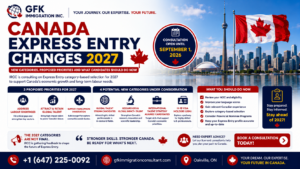
Canada Express Entry Changes 2027: New Categories, Proposed Priorities and What Candidates Should Do Now
Canada Express Entry changes for 2027 could significantly reshape how skilled workers are selected for permanent residence. Immigration, Refugees and Citizenship Canada (IRCC) is consulting Canadians and stakeholders on the economic priorities and categories that could guide Express Entry category-based draws in 2027.
The consultation, launched on August 4, 2026, is open until September 1, 2026. Importantly, these are proposed changes—not finalized 2027 Express Entry rules. The outcome could influence which occupations and talent groups receive targeted invitations to apply (ITAs) for Canadian permanent residence next year.
For Express Entry candidates in Canada and abroad, the message is clear: do not wait until 2027 to prepare.
What Are the Proposed Canada Express Entry Changes for 2027?
IRCC is reviewing its category-based selection system to determine which economic priorities should receive targeted Express Entry invitations in 2027.
The consultation is considering three broad priorities:
- Addressing long-term labour shortages
- Attracting and retaining high-value global talent
- Supporting Francophone immigration outside Quebec
These priorities build on Canada’s existing approach to category-based Express Entry selection while allowing IRCC to adjust categories according to labour-market conditions, immigration priorities and Canada’s economic needs.
Are the 2027 Express Entry categories final?
No.
This is one of the most important points candidates should understand.
IRCC has not yet finalized the 2027 categories. The current consultation is intended to gather feedback before the department determines which categories should continue, change or potentially be added.
Therefore, candidates should not assume that a proposed category guarantees an Express Entry draw in 2027.
Which Express Entry Categories Are Being Considered for 2027?
Canada currently has 10 Express Entry categories for 2026:
- French-language proficiency
- Healthcare and social services occupations
- STEM occupations
- Trade occupations
- Education occupations
- Transport occupations
- Physicians with Canadian work experience
- Researchers with Canadian work experience
- Senior managers with Canadian work experience
- Skilled military recruits
IRCC’s 2027 consultation asks respondents to consider whether many of these categories should continue into 2027. The skilled military recruits category is treated separately in the consultation questionnaire.
This means candidates working in healthcare, education, skilled trades, STEM, transportation and other priority occupations should closely monitor the final 2027 announcement.
4 Potential New Express Entry Categories for 2027
One of the most significant parts of the consultation is IRCC’s consideration of additional categories focused on attracting highly skilled international talent.
1. Global Talent Stream Candidates
IRCC is considering whether candidates working in occupations associated with Canada’s Global Talent Stream should receive targeted consideration through Express Entry.
The Global Talent Stream is designed to help Canadian employers access highly skilled international workers, particularly in specialized areas such as technology.
If a dedicated Express Entry category is eventually introduced, professionals in qualifying technology and other Global Talent Stream occupations could potentially have another route toward Canadian permanent residence.
However, this is currently a proposal, not a confirmed 2027 immigration pathway.
2. Researchers and Global Impact+ Talent
Researchers are another major focus.
Canada already introduced a researcher category in its 2026 Express Entry selection strategy, alongside categories for physicians and senior managers with Canadian work experience.
The 2027 consultation is examining whether researcher-focused selection should be expanded or strengthened, including alignment with Canada’s broader efforts to attract internationally recognized research talent.
For researchers, scientists and highly specialized professionals, this could become an important area to watch.
3. Candidates Aligned With Canada’s International Talent Strategy
Canada is increasingly focused on attracting highly skilled workers who can contribute to strategic sectors and emerging industries.
The federal government’s International Talent Attraction Strategy emphasizes Canada’s need to compete globally for talent while supporting areas such as healthcare, emerging technologies and skilled trades.
A future Express Entry category could potentially prioritize candidates whose skills and experience align with these national talent priorities.
Again, candidates should treat this as a proposal under consultation, rather than a guaranteed immigration category.
4. H-1B Visa Holders in the United States
Another proposed direction that has attracted considerable attention is a potential Express Entry category for H-1B visa holders working in the United States.
Canada has previously taken steps to attract highly skilled U.S.-based professionals, and federal policy has identified accelerated pathways for certain high-skilled workers as part of its broader talent strategy.
If a dedicated Express Entry category for H-1B holders is ultimately introduced, eligible professionals in areas such as technology, healthcare, research and other specialized fields could potentially have an additional Canadian permanent residence option.
At present, however, there is no finalized 2027 Express Entry H-1B category.
Could Canada Reduce the Number of Eligible Occupations?
Yes, this is another important issue under consideration.
IRCC is asking whether category-based selection should continue covering broad groups of occupations experiencing long-term shortages or become more targeted.
A narrower approach could mean that some occupations currently benefiting from category-based selection may not remain eligible in the same way in 2027.
IRCC is considering factors such as:
- The persistence of labour shortages
- Canada’s economic priorities
- Occupation skill levels
- Labour-market projections
- Whether other immigration programs already address the same occupations
- The needs of specific sectors and regions
This could make occupation selection and NOC classification even more important for Express Entry candidates.
French-Language Express Entry Candidates Could Remain Strongly Positioned
French-language proficiency has become one of the most important components of Canada’s category-based Express Entry strategy.
In 2025, French-language proficiency accounted for 50,701 invitations among category-eligible candidates, representing 49.2% of category-eligible invitations in the data cited by Immigration News Canada from IRCC operational information.
Canada has also established increasing targets for French-speaking permanent residents outside Quebec.
Under the 2026–2028 Immigration Levels Plan, the target share for French-speaking permanent residents outside Quebec is:
- 9% in 2026
- 9.5% in 2027
- 10.5% in 2028
Canada has also committed to increasing the target to 12% by 2029.
For candidates who can demonstrate strong French-language ability, this makes French proficiency an increasingly valuable part of a Canadian immigration strategy.
For the French-language category, candidates generally need a minimum NCLC 7 in all four language abilities, along with the other requirements applicable to the specific Express Entry round.
What Could These Changes Mean for CRS Scores?
One common question is:
“Will the 2027 Express Entry changes lower the CRS score?”
There is no reliable way to predict a specific CRS cutoff at this stage.
Category-based draws and general Express Entry draws operate differently. A candidate may benefit from category eligibility even when their CRS score would not be competitive in a large general draw, but they still need to meet the requirements of the particular category and round.
IRCC ranks eligible candidates according to their CRS score during category-based rounds and invites the highest-ranking candidates who meet the category requirements.
Therefore, candidates should focus less on guessing a future CRS cutoff and more on building the strongest possible profile.
What About Express Entry in 2026?
The proposed 2027 changes do not replace the current 2026 Express Entry system.
IRCC’s current 2026 categories include French-language proficiency, healthcare and social services, STEM, trades, education, transport, physicians with Canadian work experience, researchers, senior managers and skilled military recruits.
Candidates should continue using the rules and eligibility requirements currently in effect unless and until IRCC officially announces changes.
This is particularly important for people who are already eligible for a 2026 category-based draw.
If you qualify today, do not delay your immigration plans simply because 2027 categories are being discussed.
What Should Express Entry Candidates Do Now?
The proposed 2027 changes provide a useful opportunity to review your immigration strategy before the final categories are announced.
1. Review Your NOC Code
Your occupation is central to category-based selection.
Make sure your claimed NOC accurately reflects your actual job duties—not simply your job title.
An incorrect NOC can create serious problems with eligibility and the accuracy of your Express Entry profile.
2. Improve Your Language Scores
Language ability can significantly influence your CRS score and category eligibility.
If your English or French results are several years old, approaching expiry, or below your potential, consider retaking the approved language test.
For French-speaking candidates, improving French proficiency could be particularly valuable given Canada’s continued Francophone immigration priorities.
3. Look at Your Canadian Work Experience
Canadian work experience is becoming increasingly relevant to Canada’s economic immigration strategy.
IRCC’s current 2026 strategy specifically includes categories for physicians, researchers and senior managers with Canadian work experience.
4. Explore Category-Based Selection
Do not rely exclusively on general Express Entry draws.
Review whether your occupation, language ability or professional background could make you eligible for a category-based round.
5. Consider Provincial Nominee Programs
Express Entry should not be viewed in isolation.
A Provincial Nominee Program (PNP) may provide another pathway to permanent residence for candidates whose occupation, work experience or destination aligns with provincial priorities.
A provincial nomination through an Express Entry-linked stream can add 600 CRS points, although PNP eligibility and selection remain separate from federal category-based selection.
6. Keep Your Express Entry Profile Accurate
Do not add experience, education, language results or other information simply because you believe it could improve your chances.
Your profile should accurately reflect your qualifications and supporting documentation.
IRCC can assess the accuracy of the information provided when processing a permanent residence application.
Can Candidates Participate in the 2027 IRCC Consultation?
Yes.
IRCC’s consultation is open to individuals and organizations, including people living outside Canada.
The consultation is scheduled to remain open until September 1, 2026.
The questionnaire asks participants for their views on existing categories, potential new talent categories, occupation targeting and Francophone immigration priorities.
This consultation does not mean that submitting a response will give an individual an Express Entry advantage or guarantee an invitation.
Its purpose is to help IRCC assess economic priorities before establishing the 2027 category-based selection framework.
When Will Canada Announce the Final 2027 Express Entry Categories?
IRCC has not provided a guaranteed public announcement date for the final 2027 categories.
The consultation must first close, after which IRCC can consider public feedback, labour-market information, past Express Entry results and input from federal, provincial and territorial partners.
Candidates should therefore be cautious about websites or social-media posts presenting proposed 2027 categories as already confirmed.
Until IRCC officially establishes the 2027 categories, they should be treated as proposals.
Frequently Asked Questions About Canada Express Entry Changes 2027
What are the new Express Entry changes for 2027?
IRCC is consulting on potential changes to Express Entry category-based selection for 2027. Proposed areas include continued selection for priority occupations, stronger talent-focused categories and possible changes to how labour-shortage occupations are targeted.
Are the 2027 Express Entry categories confirmed?
No. The categories under discussion are not final. IRCC’s consultation is part of the process used to determine future economic priorities.
Will French-language Express Entry draws continue in 2027?
French-language proficiency is expected to remain an important immigration priority because Canada has established increasing Francophone admission targets outside Quebec. However, the final 2027 category framework has not yet been announced.
Could H-1B holders get a Canadian Express Entry pathway in 2027?
A dedicated category for H-1B visa holders in the United States is among the proposals being considered. It is not currently a finalized Express Entry category.
Could healthcare and skilled trades categories change?
Yes. IRCC is considering whether labour-shortage categories should cover the same broad range of occupations or become more targeted based on labour-market needs and government priorities.
Should I wait until 2027 to create my Express Entry profile?
Not necessarily. If you are eligible for Express Entry or a 2026 category-based draw now, waiting could mean missing an opportunity. Your best strategy depends on your CRS score, occupation, language ability, work experience, education and other circumstances.
Will the 2027 changes affect Express Entry draws in 2026?
No. The consultation is forward-looking and does not itself change the current 2026 Express Entry categories or draw rules.
Final Takeaway: Prepare for the Direction of Canada’s Express Entry System
Canada’s proposed Express Entry changes for 2027 point toward a more targeted, skills-focused and talent-driven immigration system.
The direction is becoming clearer: Canada wants immigrants who can address critical labour needs, contribute to innovation and productivity, strengthen Francophone communities and support long-term economic growth.
But candidates should not make major immigration decisions based solely on proposed categories.
The 2027 Express Entry categories are not final yet.
For now, the smartest approach is to strengthen the factors you can control:
- Improve your English or French language scores
- Verify your NOC and occupation eligibility
- Build qualifying work experience
- Increase your CRS score where possible
- Explore category-based selection
- Review relevant PNP options
- Keep your Express Entry profile accurate and updated
- Monitor official IRCC announcements
If you are planning to immigrate to Canada through Express Entry in 2026 or 2027, early preparation can give you more options when the rules change.
Need Help With Your Express Entry Strategy?
GFK Immigration Inc. helps prospective immigrants assess their Canadian immigration options, understand Express Entry requirements and develop a strategy based on their individual qualifications.
Your Journey. Our Expertise. Your Future.
📞 +1 (647) 225-0092
🌐 GFK Immigration Consultant – Helping you on your immigration journey to make Canada home.
📍 Oakville, Ontario
This article is for general informational purposes only and should not be considered legal or immigration advice. Canadian immigration policies and Express Entry categories can change. Always verify the latest requirements with IRCC or consult a qualified Canadian immigration professional before making an application.
#ExpressEntry2027 #CanadaImmigration #ExpressEntryCanada #CanadianPR #IRCC #CanadaPR #ImmigrationCanada #SkilledWorkersCanada #CRS #CanadaVisa #GFKImmigration #ImmigrateToCanada