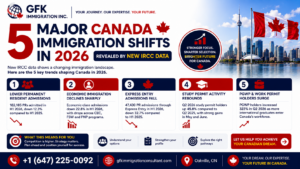
5 Major Canada Immigration Shifts in 2026 Revealed by New IRCC Data
Canada immigration is changing rapidly in 2026. New IRCC data shows fewer permanent resident admissions, a sharp decline in Express Entry landings, a rebound in study permits and a dramatic increase in post-graduation work permit activity. Here are the five biggest immigration trends applicants, international students, temporary workers and employers should understand.
Canada’s immigration system is going through a significant recalibration in 2026.
New Immigration, Refugees and Citizenship Canada (IRCC) data covering the first half of 2026 reveals a much more complicated picture than simply saying Canada is “reducing immigration.”
Permanent resident admissions have fallen compared with 2025, while economic immigration has declined even more sharply. At the same time, study permit activity rebounded during the second quarter, and the number of International Mobility Program work permit holders increased substantially.
One of the biggest developments is the surge in Post-Graduation Work Permit (PGWP) holders entering Canada’s labour market.
These trends matter because many international students and temporary workers ultimately hope to transition to Canadian permanent residence.
Here are the five major Canada immigration shifts in 2026 and what they could mean for people planning to study, work or settle permanently in Canada.
1. Canada’s Permanent Resident Admissions Are Down in the First Half of 2026
Canada admitted 182,185 new permanent residents between January and June 2026, compared with 207,850 during the same period in 2025.
That represents a decline of approximately 12.3% year over year.
However, the monthly numbers suggest that the pace improved as the year progressed.
January recorded 24,220 permanent resident admissions, while June reached 34,750.
Canada’s 2026–2028 Immigration Levels Plan sets the country’s permanent resident admission target at 380,000 for 2026. To reach that annual target, approximately 197,815 additional permanent residents would need to be admitted during the second half of the year.
That means Canada would need to average roughly 33,000 permanent resident admissions per month from July through December.
The June figure of 34,750 shows that this pace is possible, although maintaining it consistently will be important.
What does this mean for immigration applicants?
The lower first-half numbers do not mean that Canada has stopped accepting permanent residents.
Instead, they show that the immigration system is operating within a more controlled intake environment.
For applicants, this means competition for available permanent residence spaces may remain significant, particularly within economic immigration programs.
2. Economic Immigration Has Fallen Even More Sharply
The second major trend is the decline in economic-class immigration.
Canada admitted approximately 100,930 economic-class permanent residents during the first six months of 2026, compared with 130,770 during the same period in 2025.
That is a decline of about 22.8%.
The reduction was visible across several major economic programs.
| Economic stream | H1 2025 | H1 2026 | Change |
|---|---|---|---|
| Canadian Experience Class | 32,730 | 23,670 | -27.7% |
| Federal Skilled Worker | 35,865 | 26,820 | -25.2% |
| Provincial Nominee Program | 50,585 | 41,820 | -17.3% |
| Economic total | 130,770 | 100,930 | -22.8% |
The Canadian Experience Class (CEC) experienced one of the largest declines.
This is particularly important because CEC is one of the principal pathways used by temporary workers and international graduates who gain qualifying Canadian work experience.
Canada’s immigration strategy is increasingly focused on attracting and retaining people who can address specific labour-market needs.
IRCC’s 2026 Express Entry categories include priorities such as health care and social services, trades, transport occupations, researchers and senior managers with Canadian work experience, French-language proficiency and certain medical professionals.
What does this mean?
Having Canadian work experience remains valuable, but simply being eligible for an economic immigration program does not guarantee an invitation or permanent residence.
Applicants increasingly need to think strategically about:
- CRS score
- Occupation
- Canadian work experience
- Language ability
- Provincial nomination opportunities
- Category-based Express Entry selection
- Timing of their temporary status
3. Express Entry Permanent Resident Admissions Fell 32.7%
Perhaps the most important development for Express Entry candidates is the sharp decline in actual permanent resident admissions through the system.
IRCC data recorded 47,430 Express Entry permanent resident admissions in the first half of 2026, compared with 70,445 during the first half of 2025.
That represents a 32.7% decline.
This is different from simply counting Express Entry Invitations to Apply (ITAs).
An ITA is an invitation to submit a permanent residence application. A permanent resident admission happens later, after the application has been processed and the applicant lands as a permanent resident.
That distinction is extremely important.
Why are Express Entry admissions falling?
There is a natural time lag between an invitation, application processing and final admission.
Therefore, changes in Express Entry draw sizes and candidate profiles can take months to appear in permanent resident landing data.
At the same time, Canada has been operating within lower overall immigration targets.
The 2026–2028 Levels Plan targets 380,000 permanent residents in 2026 and places greater emphasis on economic immigration and labour-market priorities.
IRCC has also been examining possible reforms to Express Entry and the Comprehensive Ranking System.
The department’s 2026 consultation explored ways to make the system more responsive to economic outcomes and Canada’s labour-market priorities. Those potential reforms are being considered for future implementation and should not be confused with rules that are already in force.
What should Express Entry candidates do?
Candidates should not rely exclusively on the possibility of a lower CRS cutoff.
Instead, applicants should look for legitimate ways to strengthen their profiles, including:
- Improving English or French language scores
- Obtaining additional eligible work experience
- Exploring Provincial Nominee Programs
- Maintaining an accurate Express Entry profile
- Monitoring category-based draws
- Reviewing eligibility for French-language selection
- Keeping temporary status valid where applicable
4. Study Permit Activity Rebounded in the Second Quarter of 2026
The international student story is more complicated.
After Canada’s study permit restrictions and reduced temporary resident targets, study permit activity declined significantly in early 2026.
However, the second quarter produced a notable rebound.
IRCC data shows 80,485 study permit holders whose permits became effective during Q2 2026, compared with 55,215 during Q2 2025.
That represents an increase of approximately 45.8%.
June was particularly strong, with 32,700 study permit holders compared with 18,170 in June 2025.
However, this does not mean Canada has abandoned its international student restrictions.
Canada’s 2026 immigration framework continues to reduce the number of new temporary residents.
For 2026, the government has set a target of 155,000 new international student arrivals, which is 49% lower than the previous year’s target.
This means students should not interpret the Q2 increase as an unlimited reopening of Canada’s international education system.
Which countries saw notable changes?
The latest data shows significant differences among major source countries.
For example, Q2 study permit activity increased substantially for China, Ukraine, South Korea and France, while India experienced a decline compared with Q2 2025.
Nigeria also recorded an increase in the data.
For Nigerian students considering Canada, this reinforces an important point: approval should never be assumed simply because overall study permit numbers have increased.
Applicants still need to demonstrate that they meet Canada’s current study permit requirements, including the requirements related to their program, financial capacity and temporary resident status.
5. Post-Graduation Work Permit Activity Has Surged
The most dramatic shift in the latest data involves Canada’s International Mobility Program (IMP).
IRCC recorded 258,765 IMP work permit holders in Q2 2026, compared with 126,415 during Q2 2025.
That represents an increase of more than 100%.
But there is an important reason behind much of this increase.
PGWP holders are driving a large part of the growth
IRCC data shows 116,935 Post-Graduation Work Permit holders in Q2 2026, compared with 27,645 during Q2 2025.
That represents a remarkable 323% year-over-year increase.
June alone recorded 42,470 PGWP holders, compared with 9,780 in June 2025.
This surge is largely connected to the international student cohorts admitted during the much larger post-pandemic international education period.
Students who entered Canada under earlier rules are now completing their programs and transitioning into the Canadian labour market.
This creates a major policy challenge.
Canada has tightened international student intake and changed PGWP eligibility requirements, but the effects of those changes take time to appear because students who entered under earlier rules still have to complete their programs.
Why does this matter for permanent residence?
This is one of the most important questions facing international graduates in Canada.
A PGWP can provide valuable Canadian work experience, but holding a PGWP does not automatically lead to permanent residence.
The latest data highlights the gap.
A very large number of PGWP holders are entering the Canadian labour market, while a much smaller number are transitioning to permanent residence.
That creates greater competition among international graduates seeking pathways such as:
- Canadian Experience Class
- Provincial Nominee Programs
- Category-based Express Entry
- Regional immigration programs
- Other eligible economic immigration pathways
For international students, the lesson is clear:
A study permit should be viewed as part of an immigration strategy—not as a guarantee of permanent residence.
What These Five Immigration Trends Mean for Canada in 2026
When the numbers are viewed together, a much clearer picture emerges.
Canada is not simply “cutting immigration.”
Instead, the country is attempting to rebalance the immigration system.
The government is reducing new temporary resident targets while maintaining a significant permanent resident intake and placing greater emphasis on people who can contribute to specific labour-market needs.
The 2026 plan targets:
- 380,000 permanent residents
- 155,000 new international students
- 230,000 new temporary workers
Canada also intends to increase the economic share of permanent resident admissions in the coming years.
At the same time, the government has introduced targeted initiatives to transition certain people already in Canada to permanent residence.
One such initiative aims to transition up to 33,000 skilled temporary workers to permanent residence during 2026 and 2027, particularly workers contributing to communities and sectors with labour needs.
This suggests that Canada’s immigration strategy is increasingly focused on selection, retention and economic contribution rather than simply increasing the number of newcomers entering the country.
What International Students and Temporary Workers Should Do Now
If you are already in Canada, the current environment makes planning more important than ever.
1. Check your immigration status
Know exactly when your study permit, work permit or other temporary status expires.
Do not wait until the final weeks before exploring your options.
2. Calculate your CRS score
If permanent residence through Express Entry is your goal, understand your current CRS score and identify realistic opportunities to improve it.
3. Explore Provincial Nominee Programs
A provincial nomination can significantly change an Express Entry candidate’s competitiveness.
Each province and territory has different requirements, occupations and priorities.
4. Improve your language results
English and French remain among the most important factors in Canada’s economic immigration system.
Improving a language score can potentially increase CRS points and may also make a candidate eligible for category-based selection.
5. Consider French-language opportunities
Canada continues to support Francophone immigration outside Quebec.
The 2026–2028 plan includes specific targets for French-speaking permanent residents outside Quebec, and IRCC has continued to use French-language proficiency as an Express Entry category.
6. Keep your documents and profile accurate
A change in employment, marital status, education, language results or work experience can affect an immigration application.
Make sure your information remains accurate and up to date.
The Bottom Line
The latest IRCC data shows that Canada immigration in 2026 is becoming more targeted, competitive and strategically driven.
Permanent resident admissions are lower than in 2025. Economic immigration has contracted further, while Express Entry admissions have fallen sharply.
At the same time, study permit activity rebounded in Q2 and Canada’s PGWP population has surged as earlier international student cohorts graduate and enter the labour market.
For prospective immigrants, international students and temporary workers, this creates both challenges and opportunities.
The biggest mistake is assuming that Canada’s immigration system is moving in only one direction.
It is changing across multiple streams at the same time.
The best strategy is therefore to understand where you fit within Canada’s current immigration priorities, how competitive your profile is and which pathway may offer the most realistic route to permanent residence.
Frequently Asked Questions About Canada’s Immigration Changes in 2026
Is Canada reducing immigration in 2026?
Canada is reducing targets for new temporary residents while maintaining a permanent resident target of 380,000 for 2026. The government is also placing greater emphasis on economic immigration and labour-market priorities.
How many permanent residents has Canada admitted in 2026?
IRCC data cited in the latest release shows that Canada admitted 182,185 permanent residents between January and June 2026, compared with 207,850 during the same period in 2025.
Are Express Entry admissions falling in 2026?
Yes. The latest data shows 47,430 Express Entry permanent resident admissions during the first half of 2026, compared with 70,445 during the same period in 2025.
Does having a PGWP guarantee Canadian permanent residence?
No. A Post-Graduation Work Permit allows eligible graduates to gain Canadian work experience, but it does not guarantee permanent residence. Graduates must qualify for an available immigration pathway and meet its requirements.
Why have PGWP numbers increased so much in 2026?
The increase is largely connected to international students who entered Canada during earlier periods of high study permit issuance and are now completing their programs and transitioning into the Canadian workforce.
Will Express Entry change in 2027?
Potential changes are being considered. IRCC conducted consultations in 2026 on possible Express Entry and CRS reforms. However, proposed or consulted changes should not be treated as final immigration rules until officially announced and implemented.
What should international students in Canada do in 2026?
Students should understand their PGWP eligibility, monitor their study and work permit status, gain qualifying Canadian work experience where possible, monitor Express Entry and provincial programs, and assess their potential CRS score well before their temporary status expires.
What is the biggest Canada immigration trend in 2026?
One of the clearest trends is the growing emphasis on managing temporary resident volumes while prioritizing permanent immigration linked to labour-market needs. At the same time, a large cohort of international graduates is entering the workforce, creating increased competition for permanent residence.
Important Note
Canadian immigration rules, processing policies, program requirements and invitation patterns can change. Statistics discussed above reflect the latest IRCC data available for the reporting periods referenced and should not be interpreted as a guarantee of future Express Entry draws, visa approvals or permanent residence outcomes.
For an individual immigration assessment, applicants should review their circumstances and the latest official IRCC requirements before making decisions.
GFK Immigration Inc. can help you understand how Canada’s changing family sponsorship rules may affect your situation and identify the appropriate pathway for your family.
 +1 (647) 225-0092
 GFK Immigration Consultant – Helping you on your immigration journey to make Canada home.
 Oakville, Ontario
This article is for general informational purposes and does not constitute legal advice. Canadian immigration policies can change, and eligibility depends on individual circumstances. Always verify current requirements with IRCC or consult an authorized Canadian immigration professional before submitting an application.