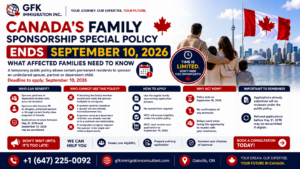
Canada’s Family Sponsorship Special Policy Ends September 10, 2026: What Affected Families Need to Know
Families affected by Canada’s rules on undeclared family members have an important deadline approaching.
Immigration, Refugees and Citizenship Canada (IRCC) currently has a temporary public policy that allows certain Canadian permanent residents to sponsor a spouse, partner or dependent child who was not declared or examined during the sponsor’s original permanent residence application.
That policy is scheduled to end on September 10, 2026.
IRCC’s official guidance confirms that applications received between May 31, 2019, and September 10, 2026, can be considered under the public policy.
For eligible families who have not yet applied, the deadline is significant because there is currently no official confirmation that the policy will be extended again.
What Is Canada’s Undeclared Family Members Public Policy?
Canada normally requires permanent residence applicants to declare all family members, even when those family members are not accompanying them to Canada.
This can include:
- Spouses
- Common-law partners
- Dependent children
- Certain grandchildren who qualify as dependent children
These family members generally must also undergo the required medical, background and security checks.
Under Canada’s immigration regulations, a person who became a permanent resident without declaring an eligible family member can normally be prevented from sponsoring that person later.
The temporary public policy provides an exemption for certain groups who would otherwise face this sponsorship barrier.
Why was the policy created?
The measure was introduced because the lifetime sponsorship bar could have particularly serious consequences for vulnerable families, including children who had no control over whether their parents declared them during an earlier immigration application.
The policy has been renewed through successive public policies since 2019.
The current policy, however, has a defined end date: September 10, 2026.
Who Can Benefit From the Policy?
Not everyone with an undeclared family member qualifies.
The policy is targeted at specific situations.
The previously undeclared family member must generally be seeking sponsorship as a:
- Spouse
- Common-law partner
- Conjugal partner
- Dependent child
The sponsor must also have obtained permanent residence through one of the qualifying pathways identified by IRCC.
These include situations where the sponsor became a permanent resident:
1. As a resettled refugee
This includes Convention refugees and people in similar circumstances who were resettled in Canada.
2. As a protected person
The policy can apply to people who became permanent residents after being recognized as protected persons under Canada’s refugee protection system.
3. Through family-class sponsorship
The sponsor may qualify if they previously became a permanent resident after being sponsored as a spouse, common-law partner, conjugal partner or dependent child.
4. As a spouse or common-law partner sponsored inside Canada
People who obtained permanent residence through the spouse or common-law partner in Canada class can also fall within the eligible categories.
Important: Meeting one of these categories does not automatically guarantee approval. IRCC must still determine whether the applicant and sponsor satisfy the applicable requirements.
Who Cannot Use This Special Policy?
The public policy has important exclusions.
A previously undeclared family member generally cannot benefit from the policy if declaring that person during the original immigration application would have made the sponsor ineligible to immigrate to Canada.
For example, IRCC identifies situations involving:
- A person who immigrated as a spouse but was already married to or in a common-law relationship with the undeclared family member.
- Someone who came to Canada as a dependent child but was already married or in a common-law relationship.
- A person who immigrated through a program that required them to be single and without dependants.
Other admissibility requirements may also continue to apply.
Therefore, an applicant should not assume that an undeclared family member automatically qualifies simply because the sponsor is a Canadian permanent resident.
What Is the Deadline?
September 10, 2026
This is the key date for affected families.
IRCC states that the public policy applies to applications it receives between May 31, 2019, and September 10, 2026.
The important point is when IRCC receives the application, rather than when the application is eventually finalized.
This means eligible families should not wait until the final days to begin preparing.
Is There a Special Application Form?
No.
One of the most important details about this policy is that there is no separate application process specifically for undeclared family members.
Eligible applicants use the normal family sponsorship process for a:
- Spouse
- Common-law partner
- Conjugal partner
- Dependent child
IRCC then determines whether the public policy exemption applies while processing the application.
This makes preparation especially important because a family should ensure that its underlying sponsorship application is complete and properly documented.
What Happens to Applications Already Submitted?
If you have already submitted an eligible sponsorship application and it is still being processed, the expiry of the public policy does not mean you automatically lose the benefit.
IRCC states that applications already submitted will be reviewed to determine whether they qualify under the public policy.
In other words, applicants should not assume that their case must be finalized before September 10.
The critical issue is whether the application was received while the policy was still in effect.
What If My Previous Application Was Refused?
There may still be an opportunity for some applicants.
IRCC states that people whose applications to sponsor undeclared family members were refused before May 31, 2019 may submit a new application if they meet the current public policy requirements.
However, the new application must still be received before the September 10, 2026 deadline.
What Happens After September 10, 2026?
This is where affected families need to be particularly careful.
The current public policy is scheduled to end on September 10, 2026.
At this time, there is no official confirmation that another extension will be introduced.
If the policy expires without a replacement or permanent regulatory change, applicants who do not qualify under another available immigration pathway could once again face the normal restrictions surrounding previously undeclared family members.
Therefore, affected families should not build their immigration plans around the assumption that the policy will automatically be renewed.
What Should Eligible Families Do Now?
If you believe this policy may apply to your situation, consider taking these steps immediately.
1. Review your original immigration application
Determine:
- Which family members were declared?
- Which family members were not declared?
- What immigration program did you use to become a permanent resident?
- Were the circumstances different when you originally applied?
Your original immigration history can be critical to determining eligibility.
2. Confirm your family relationship
Collect documentation establishing the relationship, such as:
- Marriage certificates
- Birth certificates
- Adoption records
- Proof of common-law relationship
- Other relevant civil documents
3. Check your eligibility carefully
Do not assume that having an undeclared spouse or child is enough.
The sponsor’s original immigration pathway and circumstances can determine whether the public policy applies.
4. Prepare the sponsorship application early
Incomplete applications can create serious problems when a policy has a fixed deadline.
Give yourself sufficient time to identify missing documents, obtain translations where required and address potential complications.
5. Pay attention to the September 10 deadline
IRCC must receive the application by September 10, 2026.
Do not wait until the last possible day.
6. Get professional advice if your case is complicated
Cases involving undeclared family members can involve complex immigration histories.
If you are uncertain about your eligibility, consider speaking with a licensed Canadian immigration professional before submitting an application.
What About Parents and Grandparents?
It is important not to confuse this special public policy with Canada’s Parents and Grandparents Program (PGP).
They are separate immigration matters.
IRCC currently states that it is not accepting new applications under the Parents and Grandparents Program, following the July 15, 2026 pause. Existing applications continue to be processed.
The policy discussed in this article specifically concerns certain previously undeclared spouses, partners and dependent children.
Frequently Asked Questions
When does Canada’s family sponsorship special policy end?
The public policy for eligible undeclared family members ends September 10, 2026. IRCC’s guidance states that applications received up to that date can be considered under the policy.
Can I sponsor an undeclared spouse after September 10, 2026?
It depends on whether another immigration provision or policy applies to your circumstances. The current special exemption itself is scheduled to end September 10, 2026, so eligible applicants should not assume they will have the same option after that date.
Is there a special form for undeclared family members?
No. IRCC says applicants should use the normal sponsorship process for a spouse, partner or child. IRCC determines whether the public policy applies during processing.
Can someone who immigrated through Express Entry use this policy?
Generally, no. The policy is limited to specific groups, including certain refugees, protected persons and people who became permanent residents through qualifying family-class pathways.
What happens if I apply before September 10 but IRCC processes my application later?
An application received while the policy is in effect can continue to be assessed under the policy. The application does not have to be finalized before September 10.
Will Canada extend the policy?
There is currently no official confirmation that the policy will be extended beyond September 10, 2026. Applicants who qualify should therefore plan around the published deadline rather than relying on a possible extension.
The Bottom Line for Families
Canada’s special public policy for certain undeclared family members is scheduled to end on September 10, 2026.
For eligible permanent residents, this could represent an important opportunity to reunite with a spouse, partner or dependent child who was not declared during the original immigration process.
But eligibility is highly specific.
If you believe you may qualify, review your immigration history now, gather your documents and seek professional guidance before submitting your sponsorship application.
For official eligibility information, applicants should always verify the latest requirements directly with Immigration, Refugees and Citizenship Canada (IRCC).
GFK Immigration Inc. can help you understand how Canada’s changing family sponsorship rules may affect your situation and identify the appropriate pathway for your family.
📞 +1 (647) 225-0092
🌐 GFK Immigration Consultant – Helping you on your immigration journey to make Canada home.
📍 Oakville, Ontario
This article is for general informational purposes and does not constitute legal advice. Canadian immigration policies can change, and eligibility depends on individual circumstances. Always verify current requirements with IRCC or consult an authorized Canadian immigration professional before submitting an application.