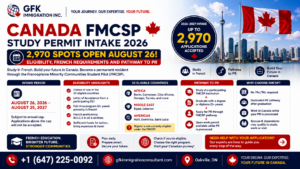
Canada FMCSP Study Permit Intake 2026: 2,970 Spots Open August 26 — Eligibility, French Requirements and Pathway to PR
Meta Title: Canada FMCSP Study Permit 2026: 2,970 Spots Open August 26
Meta Description: Canada’s FMCSP study permit intake opens August 26, 2026, with 2,970 spots. Learn eligibility, 33 eligible countries, French requirements, participating schools and the pathway to PR.
Suggested URL Slug: /canada-fmcsp-study-permit-intake-2026/
Primary Keyword: Canada FMCSP study permit 2026
Secondary Keywords: FMCSP 2026, Francophone Minority Communities Student Pilot, Canada study permit, French-speaking students Canada, FMCSP permanent residence, Canada PR pathway, study in Canada in French
Search Intent: Informational + Immigration Planning
Target Geography: Canada, Africa, Francophone countries, Middle East, Caribbean/Americas
Canada FMCSP Study Permit Intake 2026: 2,970 Applications Open August 26
French-speaking international students from eligible countries have another opportunity to study in Canada through the Francophone Minority Communities Student Pilot (FMCSP), a program designed to support French-language education and create a pathway from study to permanent residence outside Quebec.
For the 2026–2027 intake year, Immigration, Refugees and Citizenship Canada (IRCC) can accept up to 2,970 qualifying study permit applications under the FMCSP.
The new intake period begins August 26, 2026, and runs until August 25, 2027, subject to the annual application cap. Applications received after the applicable cap is reached will not be accepted for processing and will be returned.
That makes preparation particularly important for prospective students who qualify.
What Is the FMCSP?
The Francophone Minority Communities Student Pilot is a Canadian immigration program for eligible French-speaking international students who want to study at participating post-secondary institutions outside Quebec.
Unlike a conventional study-to-work pathway, the FMCSP was designed as a temporary-residence-to-permanent-residence pathway.
Eligible students can study in French at a participating institution, complete their qualifying program and potentially apply for permanent residence through the FMCSP’s dedicated PR pathway after graduation.
The program also supports Canada’s broader objective of strengthening Francophone and Acadian minority communities outside Quebec.
In simple terms:
Eligible country → FMCSP study permit → qualifying French-language program → graduation → FMCSP permanent residence pathway → potential open work permit while PR is processed.
When Does the 2026 FMCSP Intake Open?
The next FMCSP study permit intake opens:
📅 August 26, 2026
The annual intake period runs until:
📅 August 25, 2027
The maximum number of applications that IRCC can accept under Part A of the policy during this period is:
2,970 applications
Importantly, this is an application-processing cap, not a guarantee that every applicant will receive a study permit.
If IRCC receives applications above the applicable annual cap, excess applications will not be accepted for processing and will be returned.
Practical takeaway: eligible applicants should not wait until the final months of the intake period to begin preparing.
What Changed for the 2026–2027 FMCSP Intake?
IRCC signed an updated FMCSP study-permit public policy on June 25, 2026, replacing the previous September 2025 policy.
The updated policy provides another annual intake of up to 2,970 applications and extends the study-permit component of the pilot through August 25, 2027.
The companion permanent-residence and open-work-permit policy was also updated and is currently set to expire on November 30, 2032, unless revoked or replaced earlier.
IRCC also clarified program delivery procedures in July 2026, including language-test information and the definition of a two-year program.
Who Is Eligible for the FMCSP in 2026?
This is where applicants need to pay close attention.
French proficiency alone is not enough.
To qualify for the FMCSP study-permit facilitation, the applicant must satisfy several conditions, including citizenship, education, language, financial and institutional requirements.
1. You Must Be a Citizen of an Eligible Country
The current policy identifies 33 eligible countries.
Africa
- Benin
- Burkina Faso
- Burundi
- Cabo Verde
- Cameroon
- Central African Republic
- Chad
- Comoros
- Côte d’Ivoire
- Democratic Republic of the Congo
- Republic of the Congo
- Djibouti
- Equatorial Guinea
- Gabon
- Guinea
- Guinea-Bissau
- Madagascar
- Mali
- Mauritania
- Mauritius
- Morocco
- Niger
- Rwanda
- São Tomé and Principe
- Senegal
- Seychelles
- Togo
- Tunisia
Middle East
- Egypt
- Lebanon
Americas
- Haiti
- Dominica
- Saint Lucia
These countries are tied to the regions identified by IRCC when the original FMCSP policy came into effect in August 2024.
Important for Nigerian applicants
Nigeria is not currently included in the 33-country FMCSP eligibility list.
Therefore, a Nigerian citizen cannot qualify for the FMCSP simply because they speak French or have a French-language test result.
This is particularly important for prospective students researching Canadian study-permit options from Nigeria.
2. You Need a Letter of Acceptance From a Participating DLI
Applicants must receive a Letter of Acceptance from a Designated Learning Institution (DLI) participating in the FMCSP.
The institution must have an agreement with IRCC to participate in the pilot, and the Letter of Acceptance must identify the applicant as applying through the FMCSP.
The participating institution must also maintain its FMCSP status when the study permit is issued.
3. Your Program Must Meet Specific Requirements
Your program must:
- Be at the post-secondary level
- Be full-time
- Last at least two years
- Lead to a degree or diploma
- Be taught primarily in French
- Have more than 50% of classes delivered in French
IRCC’s current program guidance confirms these requirements.
This means that simply attending a Canadian school that offers some French courses does not automatically make a program FMCSP eligible.
4. You Need French-Language Proficiency
Applicants must provide results from an approved French-language test.
The minimum requirement is:
NCLC 5 in speaking, listening, reading and writing
You must meet the minimum level in all four language abilities.
Applicants should also make sure their language-test results remain valid when they submit their application.
This requirement makes the FMCSP particularly relevant to French-speaking applicants from eligible Francophone countries.
5. You Must Meet the Financial Requirement
Applicants must demonstrate that they can cover:
- Their first year of tuition
- Their travel expenses
- The required amount of available funds based on the location of the participating institution
The FMCSP financial requirement is based on 75% of the applicable low-income cut-off (LICO) associated with the municipality where the school’s main campus is located.
IRCC currently publishes different minimum living-fund amounts depending on the community classification.
For example, for applications made on or after September 1, 2025, the published minimum for one person, excluding tuition, ranges from:
- $22,895 CAD in Group A communities
- $19,718 CAD in Group B
- $19,595 CAD in Group C
- $17,930 CAD in Group D
- $15,761 CAD in rural areas
These amounts are in addition to first-year tuition and travel costs.
Applicants should always verify the current IRCC financial table before submitting an application because financial requirements can be updated.
One Major Advantage: No PAL/TAL Required
One of the most significant FMCSP advantages is that eligible applicants are exempt from the provincial or territorial attestation-letter requirement that applies to many other international students.
IRCC confirms that FMCSP participants do not need a PAL/TAL for the study-permit application.
However, this exemption does not mean applicants are automatically approved.
Applicants must still satisfy the other applicable eligibility, admissibility and study-permit requirements.
Which Canadian Schools Participate in the FMCSP?
IRCC’s current list includes participating institutions across several provinces.
Examples include:
- Université de Saint-Boniface — Manitoba
- Université Saint Paul — Ontario
- University of Ottawa — Ontario
- Université Laurentienne — Ontario
- Université de l’Ontario français — Ontario
- York University’s Glendon campus — Ontario
- University of Alberta — Alberta
- University of Regina — Saskatchewan
- Université de Moncton — New Brunswick
- Université Sainte-Anne — Nova Scotia
- Collège de l’Île — Prince Edward Island
- Collège Éducacentre — British Columbia
- Collège Boréal
- Collège La Cité
- Collège Mathieu
- Université de Hearst
- Collège Communautaire du Nouveau-Brunswick
IRCC currently lists 17 participating DLIs, while noting that additional institutions may be added as agreements are reached.
Because participation and eligible programs can change, applicants should check the official IRCC DLI list before choosing a school or paying tuition.
What Happens After You Graduate?
This is one of the most important features of the FMCSP.
The program does not simply provide a study permit.
Eligible participants can potentially transition from their Canadian education into a dedicated permanent residence pathway.
To qualify for PR under the current policy, the graduate generally needs to:
- Have received an FMCSP study permit;
- Successfully complete the qualifying program;
- Complete at least two years of full-time study;
- Obtain a degree or diploma;
- Have studied primarily in French;
- Have studied at a participating FMCSP institution;
- Live in Canada outside Quebec;
- Maintain valid temporary status or qualify for restoration;
- Intend to live in a province or territory outside Quebec; and
- Meet applicable admissibility requirements.
No job offer is specified as a requirement under the FMCSP PR policy.
That can make this pathway particularly attractive compared with immigration routes where employment or a qualifying job offer plays a central role.
When Will FMCSP Graduates Be Able to Apply for PR?
IRCC currently states that the FMCSP permanent-residence application component is expected to open in winter 2027.
This distinction is important:
August 26, 2026 = study-permit intake
Winter 2027 = FMCSP PR application component expected to open
Therefore, someone applying for the August 2026 study-permit intake is not applying for permanent residence at the same time.
The PR pathway comes after the applicant completes the qualifying education.
Can FMCSP Graduates Work While Their PR Application Is Processing?
Yes, under the current policy, eligible FMCSP graduates who have completed their program and submitted their PR application can apply for an open work permit.
The FMCSP-specific work permit can be issued for up to three years, subject to the policy’s requirements.
IRCC states that eligible graduates can work in Canada outside Quebec while their PR application is being processed.
This is not the same as a standard Post-Graduation Work Permit (PGWP); it operates under the FMCSP’s dedicated public policy.
Eligible spouses and other family members may also benefit from temporary-residence and work-permit facilitation under the program’s rules.
Can Your Family Accompany You?
Potentially, yes.
Eligible spouses or common-law partners and dependent children may be able to obtain appropriate temporary status, including:
- Visitor visas
- Study permits
- Open work permits
Family members must provide evidence that the principal applicant is participating in or applying through the FMCSP.
The specific eligibility of each family member should be assessed separately.
Why the FMCSP Could Be Important in 2026
Canada’s international-student immigration system has become significantly more competitive.
For many students, the traditional route looks something like:
Study → PGWP → Canadian work experience → Express Entry/PNP → PR
The FMCSP offers a different structure:
FMCSP Study Permit → French-language Canadian education → FMCSP PR pathway
For eligible applicants, the program can therefore reduce dependence on some of the competitive steps associated with conventional study-to-PR strategies.
However, FMCSP is not an automatic PR program. Applicants must meet the specific conditions of the study-permit and PR policies.
FMCSP vs. Regular Canadian Study Permit
| Feature | FMCSP | Regular Study Permit |
|---|---|---|
| French-language focus | Yes | Not necessarily |
| Eligible citizenships | 33 specified countries | Much broader |
| Participating DLI required | Yes | DLI required, but not necessarily FMCSP participant |
| Program | 2+ years, primarily French | Depends on program |
| PAL/TAL | Exempt | Often required |
| French requirement | NCLC 5 in all four abilities | No general FMCSP language requirement |
| Dedicated PR pathway | Yes, subject to eligibility | No automatic dedicated PR pathway |
| CRS competition for FMCSP PR | No | Depends on eventual PR pathway |
| Open work permit after PR application | Available under FMCSP policy | Depends on applicable pathway |
The key point is that FMCSP is a specialized immigration pathway, not simply another way to obtain a Canadian study permit.
How to Prepare for the August 26, 2026 Intake
If you believe you may qualify, preparation should begin before the intake opens.
Step 1: Confirm your citizenship
Check that your country is one of the 33 countries listed by IRCC.
Step 2: Check your French level
Make sure you can meet NCLC 5 in speaking, listening, reading and writing.
Step 3: Identify a participating DLI
Choose an institution and program that meet FMCSP requirements.
Step 4: Confirm the program
Make sure it is:
- Full-time
- At least two years
- Post-secondary
- Degree/diploma leading
- Primarily taught in French
Step 5: Prepare your financial documentation
Plan for tuition, travel and the applicable FMCSP living-funds requirement.
Step 6: Prepare your study-permit documents
Your application should be complete, consistent and supported by credible documentation.
Step 7: Apply through the IRCC process
The study-permit application is submitted online through the appropriate IRCC process. The current study-permit fee is $150 CAD.
Step 8: Don’t wait for the cap to fill
Because applications above the annual cap are returned, timing can matter.
Important Warning for Prospective FMCSP Applicants
The FMCSP has attractive features, but applicants should avoid treating it as a guaranteed route to Canada or permanent residence.
A qualifying applicant still needs to satisfy applicable admissibility, documentation, financial, educational and study-permit requirements. The public policy also states that applicants remain subject to other applicable eligibility and admissibility requirements that are not specifically exempted.
Also, being French-speaking does not automatically make you eligible.
Your citizenship, institution, program, language results, finances and immigration history all matter.
Frequently Asked Questions About FMCSP 2026
What is the FMCSP?
The Francophone Minority Communities Student Pilot is a Canadian immigration program that facilitates study permits for eligible French-speaking students from specified countries and provides a dedicated pathway toward permanent residence after qualifying studies outside Quebec.
When does the 2026 FMCSP intake open?
The 2026–2027 study-permit intake opens August 26, 2026.
How many FMCSP applications will IRCC accept?
IRCC can accept up to 2,970 study-permit applications during the August 26, 2026–August 25, 2027 intake period.
Is Nigeria eligible for the FMCSP?
No. Nigeria is not currently included among the 33 eligible citizenships listed in IRCC’s FMCSP policy.
What French-language score is required?
Applicants need at least NCLC 5 in speaking, listening, reading and writing using an approved French-language test.
Do FMCSP applicants need a PAL or TAL?
No. Eligible FMCSP applicants are exempt from the provincial/territorial attestation-letter requirement.
Can FMCSP students apply for permanent residence?
Yes, eligible graduates can apply through the FMCSP’s dedicated PR pathway after completing their qualifying program and meeting the other requirements. IRCC currently indicates that the PR application component is expected to open in winter 2027.
Do I need a job offer for FMCSP permanent residence?
The current FMCSP PR policy does not list a job offer as a condition for the principal applicant’s PR application. Applicants must, however, meet all other applicable requirements.
Can FMCSP graduates work after applying for PR?
Eligible graduates can apply for an FMCSP-specific open work permit for up to three years after completing their studies and submitting their PR application.
Can my spouse come to Canada with me?
Eligible spouses/common-law partners and dependent children may qualify for temporary residence and, where applicable, work or study permits under the FMCSP framework.
Final Takeaway
The August 26, 2026 FMCSP intake creates another opportunity for eligible French-speaking international students to pursue Canadian education and potentially transition to permanent residence outside Quebec.
The combination of a 2,970-application annual cap, NCLC 5 French requirement, PAL/TAL exemption, participating French-language programs and dedicated PR pathway makes the FMCSP worth serious consideration for eligible candidates.
But the most important first step is eligibility verification. In particular, applicants should confirm that their citizenship is on IRCC’s approved 33-country list before investing in school applications or other preparation.
For applicants from Nigeria and other countries outside the FMCSP list, alternative Canadian study-permit, Express Entry, provincial nominee or other immigration pathways may be more appropriate.
Planning to study, work or settle in Canada?
GFK Immigration Inc. can help you assess your eligibility, identify a suitable immigration pathway and prepare strategically for your Canadian immigration journey.
📞 +1 (647) 225-0092
🌐 gfkimmigrationconsultant.com
📍 Oakville, Ontario
This article is for general information and does not constitute legal advice. Canadian immigration policies can change, and applicants should verify requirements with IRCC before submitting an application.