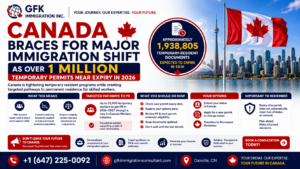
Canada Braces for Major Immigration Shift as Over 1 Million Temporary Permits Near Expiry in 2026
Canada is entering a critical phase in its immigration reset, with government data indicating that about 1.94 million temporary-resident documents are expected to expire in 2026. For workers, international students and other temporary residents, the expiry date of a permit could become one of the most important immigration deadlines to watch this year.
Canada’s immigration system is undergoing a significant transition.
After several years of rapid growth in the temporary resident population, the federal government is now focused on reducing temporary migration, tightening program management and encouraging the transition of selected workers to permanent residence.
Against this backdrop, 1,938,805 temporary-resident documents are expected to expire in 2026, according to government data cited in recent reporting. The figure covers temporary study, work and visitor documents. Importantly, it does not represent 1,938,805 unique people: one person may hold more than one document, and an expiring document does not automatically mean that someone will become out of status.
Still, the scale is significant.
For temporary residents in Canada, the central question is no longer simply “Can I stay in Canada?” It is:
What is my legal immigration status after my current authorization expires, and what should I do before that date?
What Does the 1.9 Million Expiry Figure Actually Mean?
The headline number can easily be misunderstood.
Government data indicates that 1,938,805 temporary study, work and visitor permits are expected to expire by the end of 2026. The figure represents documents rather than unique individuals.
That means an expiring permit does not automatically mean:
- 1.9 million people will become undocumented;
- 1.9 million people must leave Canada immediately;
- every permit holder will lose status;
- every person will need to return to their home country.
There are several possible outcomes.
A temporary resident may:
- Apply to extend their status.
- Apply for another eligible immigration document or pathway.
- Transition to permanent residence.
- Leave Canada before their authorized stay ends.
- Obtain maintained status where the applicable rules allow it.
- Have an application refused and subsequently need to leave or pursue another lawful option.
This distinction is critical because permit expiry and loss of legal status are not necessarily the same event.
Why 2026 Could Be a Turning Point for Canada’s Immigration System
The large number of expiring temporary-resident documents comes at the same time Ottawa is deliberately reducing the size of Canada’s temporary population.
Under the 2026–2028 Immigration Levels Plan, Canada is targeting 385,000 new temporary-resident arrivals in 2026, followed by 370,000 in both 2027 and 2028.
The 2026 target includes:
- 230,000 temporary workers
- 155,000 international students
The government has also committed to reducing Canada’s temporary population to less than 5% of the total population by the end of 2027.
This creates an important policy dynamic.
Canada is not simply replacing every temporary resident whose permit expires with a new temporary resident.
Instead, the government is attempting to reduce the overall temporary population through a combination of:
- fewer new temporary-resident arrivals;
- departures when authorized stays end;
- transitions from temporary residence to permanent residence;
- tighter program eligibility;
- increased program integrity measures.
IRCC has explicitly said that the government intends to balance new arrivals against the expected departures of international students and temporary workers whose status expires.
The Government Is Also Creating Targeted PR Opportunities
The immigration shift does not mean that every temporary resident is expected to leave Canada.
In fact, the federal government has created a one-time In-Canada Workers Initiative designed to accelerate permanent residence for up to 33,000 temporary workers in 2026 and 2027.
The initiative is targeted rather than universal.
IRCC says it is focusing on workers who are already contributing to Canadian communities, particularly smaller and rural communities with labour shortages.
Eligible workers being prioritized include individuals who have applied through certain economic immigration programs, including:
- Provincial Nominee Programs;
- Atlantic Immigration Program;
- Rural Community Immigration Pilot;
- Francophone Community Immigration Pilot;
- Home Care Worker pilots;
- Agri-Food Pilot.
Applicants generally need to have established themselves in smaller communities for at least two years under the initiative’s criteria.
IRCC’s current plan aims to admit at least 20,000 workers through this initiative in 2026, with the remaining admissions planned for 2027.
But there is an important catch.
The initiative is not a general temporary-resident-to-PR program for everyone whose permit expires.
Having a Canadian work permit does not automatically make someone eligible.
This is why temporary residents should not assume that an expiring permit will eventually lead to permanent residence.
What Happens If Your Canadian Work Permit Expires?
For temporary workers, the expiry date on a work permit is extremely important.
If you need to continue working in Canada, you should understand your options before the permit expires.
Depending on your circumstances, you may be able to apply for:
- a work permit extension;
- a new work permit;
- a different immigration status;
- permanent residence through an eligible program.
In qualifying circumstances, applying for an extension before your current status expires can allow you to remain in Canada under maintained status while IRCC processes the application.
However, maintained status is not automatic simply because someone has submitted an application. The exact rules depend on the type of application and the person’s circumstances.
This is one reason applicants should avoid waiting until the last few days before expiry.
What About International Students?
International students are also part of Canada’s temporary-resident recalibration.
The federal government has substantially reduced its targets for new international student arrivals.
Under the current 2026–2028 plan, the target for new international student arrivals is:
| Year | Student Target |
|---|---|
| 2026 | 155,000 |
| 2027 | 150,000 |
| 2028 | 150,000 |
For students already in Canada, the expiry of a study permit should be treated as a planning deadline.
Students should carefully review:
- their study permit expiry date;
- their enrolment status;
- whether they need to extend their study permit;
- their eligibility for a Post-Graduation Work Permit;
- their future permanent-residence options;
- whether they can legally work under their current authorization.
Graduation does not automatically provide permanent residence.
Likewise, receiving a Post-Graduation Work Permit does not guarantee that a graduate will qualify for Express Entry or a provincial immigration program.
Canada’s Immigration System Is Becoming More Selective
The expiry wave is happening alongside a broader shift in Canada’s immigration priorities.
The federal government says it wants immigration to better respond to:
- labour-market shortages;
- Canada’s domestic workforce;
- economic growth;
- rural and remote community needs;
- Francophone immigration;
- housing and infrastructure capacity.
Permanent residence is therefore becoming increasingly focused on candidates who can demonstrate a strong economic or community connection.
The 2026–2028 Immigration Levels Plan projects 380,000 permanent-resident admissions annually from 2026 through 2028, while the economic category is expected to represent 64% of admissions in 2027 and 2028.
For temporary residents, this means that having Canadian experience can be valuable—but Canadian experience alone is not a guarantee of PR.
Could the Expiry Wave Increase Canada’s Undocumented Population?
This is one of the most important—and most misunderstood—questions.
The answer is: it is possible, but the number cannot be determined simply by adding up expiring permits.
An expiring document can lead to several different outcomes.
Some people leave Canada.
Others obtain another status.
Some transition to permanent residence.
Others may submit applications that allow them to remain under applicable rules.
And some may eventually fall out of status.
Government officials have acknowledged the challenges involved in accurately tracking what happens to every temporary resident after an authorization expires. Recent reporting has therefore raised concerns about Canada’s ability to measure the size of the undocumented population with precision.
The key point is:
1.94 million expiring documents ≠ 1.94 million undocumented immigrants.
Any article or social-media post presenting the two numbers as equivalent would be misleading.
What Temporary Residents in Canada Should Do Now
If your Canadian permit expires in 2026, do not wait for the expiry date before planning your next step.
1. Check your exact expiry date
Look at your physical permit and verify when your current authorization ends.
Do not rely solely on the expiry date of your passport, visa counterfoil or previous immigration document.
Different documents serve different purposes.
2. Identify your next immigration pathway
Ask yourself:
Do I want to:
- remain a temporary worker?
- continue studying?
- apply for permanent residence?
- change employers?
- switch immigration programs?
- leave Canada?
Your answer should determine your strategy.
3. Review your PR eligibility early
Potential pathways may include:
- Express Entry;
- Canadian Experience Class;
- Federal Skilled Worker Program;
- Provincial Nominee Programs;
- Atlantic Immigration Program;
- community immigration pathways;
- caregiver programs;
- other targeted economic programs.
Eligibility varies significantly between programs.
4. Improve your profile
For candidates considering Express Entry, potential areas to review include:
- language test results;
- Canadian work experience;
- foreign work experience;
- education;
- Educational Credential Assessment;
- spouse or partner factors;
- provincial nomination opportunities;
- French-language ability.
5. Do not assume your employer will handle everything
Employers can play an important role in work-permit matters, but workers remain responsible for understanding their own immigration status.
If your work authorization depends on an employer-specific permit, a change in employer or employment conditions can have significant immigration consequences.
6. Keep your documents current
Make sure you have access to:
- valid passport;
- work or study permit;
- employment letters;
- pay records;
- language test results;
- education documents;
- police certificates where required;
- immigration correspondence.
Preparing these documents early can make a major difference when an application window opens.
What Canada’s 2026 Immigration Shift Means for Nigerians
For Nigerians living in Canada on temporary status, the changes deserve particular attention.
Many Nigerian temporary residents are in Canada as:
- international students;
- skilled workers;
- professionals;
- caregivers;
- family members;
- visitors.
The combination of permit expiries, tighter temporary-resident targets and increasingly targeted PR pathways means that immigration planning should happen well before status expires.
A person who arrived in Canada several years ago may have a very different set of options today than they would have had under earlier immigration policies.
This is especially relevant for international graduates whose work permits are approaching expiry.
Rather than waiting for another Express Entry draw or hoping that immigration rules will change, candidates should assess their actual eligibility and identify alternative pathways.
Is Canada Closing the Door to Temporary Residents?
No—but the rules are becoming more targeted.
Canada continues to welcome temporary workers and international students.
However, the federal government is simultaneously trying to reduce the overall temporary-resident population and align immigration with labour-market, housing and infrastructure capacity.
The result is a more selective system.
Canada’s current approach can be summarized as:
Fewer temporary arrivals + more targeted economic immigration + selected transitions to PR + stronger compliance expectations.
That combination is likely to remain an important feature of Canada’s immigration landscape through 2026 and into 2027.
What Should You Do If Your Permit Expires in 2026?
If your temporary status expires this year, don’t make your decision based on headlines or social-media predictions.
First determine:
- What type of status do you currently have?
- When exactly does it expire?
- Can you extend it?
- Are you eligible for another temporary status?
- Are you eligible for permanent residence?
- Can you qualify for Express Entry or a PNP?
- Does your employment support an immigration pathway?
- What happens if your application is refused?
These questions should be answered before your status expires, not afterward.
Frequently Asked Questions
How many temporary-resident permits are expected to expire in Canada in 2026?
Government data cited in recent reporting indicates that approximately 1,938,805 temporary study, work and visitor documents are expected to expire in 2026. This is a document count, not a count of unique people.
Does an expired Canadian permit mean I am automatically undocumented?
Not necessarily. An individual may have applied to extend or change their status, obtained another form of authorization, transitioned to permanent residence or left Canada. The legal consequences depend on the individual’s circumstances.
Can I stay in Canada after my work permit expires?
In some situations, a person who applies for an extension before their status expires may benefit from maintained status while IRCC processes the application. The rules vary depending on the application and circumstances.
Will everyone with an expiring permit have to leave Canada?
No. Some temporary residents may qualify for extensions, new permits or permanent-residence pathways. Others may need to leave Canada if they no longer have legal authorization to remain.
Is Canada offering permanent residence to temporary workers in 2026?
Canada has introduced a one-time initiative to accelerate the transition of up to 33,000 temporary workers to permanent residence in 2026 and 2027. It is targeted toward selected workers already contributing to Canadian communities and is not an automatic PR pathway for all temporary workers.
Will the 1.9 million expiring permits cause an immigration crisis?
The expiry figure alone does not establish that an immigration crisis will occur. It does, however, demonstrate the scale of temporary-status transitions Canada must manage while simultaneously reducing new temporary-resident arrivals.
What should I do if my Canadian work permit expires soon?
Review your eligibility for an extension, another work permit, permanent residence or another lawful status before your current authorization expires. If your situation is complex, professional immigration advice can help you understand the available options.
The Bottom Line
Canada is entering a new phase of immigration management.
With approximately 1.94 million temporary-resident documents expected to expire in 2026, thousands of workers, students and other temporary residents will need to make important decisions about their next immigration step.
But the number should not be interpreted as 1.94 million people automatically losing status.
The bigger story is Canada’s changing immigration strategy.
The government is reducing new temporary-resident arrivals, targeting a temporary population below 5% of the population by the end of 2027, maintaining permanent-resident admissions at 380,000 annually from 2026 to 2028, and creating targeted pathways for selected temporary workers to transition to permanent residence.
For anyone currently living in Canada on temporary status, the safest strategy is preparation—not speculation.
If your permit expires in 2026, review your options early, understand your eligibility and make sure you have a lawful plan for what comes next.
Need help planning your next step in Canada?
GFK Immigration Inc. can help you assess your immigration options, understand your eligibility and develop a strategy based on your individual circumstances.
📞 +1 (647) 225-0092
🌐 gfkimmigrationconsultant.com
📍 Oakville, Ontario
This article is intended for general informational purposes and should not be treated as legal advice. Canadian immigration rules and program requirements can change. Always verify current requirements with IRCC or a qualified Canadian immigration professional before submitting an application.
#CanadaImmigration #TemporaryResident #WorkPermitCanada #StudyPermitCanada #CanadaPR #ImmigrationCanada #IRCC #Canada2026 #PermanentResidence #GFKImmigration