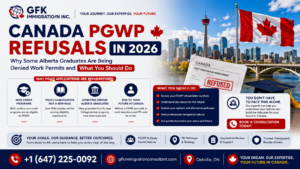
Canada PGWP Refusals in 2026: Why Some Alberta Graduates Are Being Denied Work Permits and What You Should Do
Canada’s Post-Graduation Work Permit (PGWP) remains one of the most important pathways for international students who want to gain Canadian work experience and eventually qualify for permanent residence. However, hundreds of graduates in Alberta have recently received unexpected PGWP refusals, creating uncertainty for students, employers, and educational institutions.
If you’re an international student—or planning to study in Canada—understanding what happened is essential.
What Is Happening?
In July 2026, many graduates who completed continuing education diploma programs through Portage College partner institutions in Alberta reported that their Post-Graduation Work Permit (PGWP) applications were refused by Immigration, Refugees and Citizenship Canada (IRCC).
Many of the affected graduates:
- Completed their studies successfully
- Applied for PGWPs after graduation
- Had already started working while awaiting a decision
- Later received refusal letters stating their programs were non-credit programs, making them ineligible for a PGWP.
Why Were These PGWP Applications Refused?
According to IRCC, non-credit programs are not eligible for a Post-Graduation Work Permit.
IRCC has stated that:
- The eligibility rules themselves have not changed
- A June 2026 update simply clarified an existing requirement
- Non-credit programs have never qualified for PGWPs (except limited exceptions such as eligible flight schools).
However, many graduates argue they enrolled believing their programs would qualify and only learned otherwise after completing their studies.
Who Is Affected?
Canada PGWP Refusals in 2026
Reports indicate that many affected students studied through:
- Public-private partnership arrangements
- Continuing education programs
- Certain Portage College partner campuses in Alberta
Some reports estimate that hundreds—and potentially up to 1,500 graduates—could be affected, although IRCC has not officially confirmed those figures.
Why This Matters for International Students
A PGWP is often the bridge between graduation and permanent residence.
Without it, graduates may lose the opportunity to:
- Gain eligible Canadian work experience
- Qualify for Express Entry
- Apply through Provincial Nominee Programs (PNPs)
- Continue working legally after graduation
For many students, a refusal also creates concerns about maintaining valid temporary resident status in Canada.
Can These Decisions Be Challenged?
Canada PGWP Refusals in 2026
Each immigration application is unique.
Depending on the circumstances, some applicants may wish to explore options such as:
- Requesting a reconsideration (where appropriate)
- Seeking professional legal or immigration advice
- Reviewing whether their specific program met PGWP eligibility requirements
- Exploring alternative immigration pathways if a PGWP is not available
The appropriate course of action depends on the individual’s facts and should be assessed carefully.
Lessons for Future International Students
Before accepting admission to any Canadian institution, students should verify:
✅ Whether the institution is eligible for PGWP purposes
✅ Whether the specific program qualifies—not just the school
✅ Whether the program is credit-bearing
✅ Current IRCC eligibility requirements
✅ Any recent immigration policy updates
Doing this early can help avoid costly surprises after graduation.
How GFK Immigration Inc. Can Help
If you’ve received a PGWP refusal—or you’re planning your study-to-PR journey—professional guidance can help you better understand your options.
Our team assists with:
- PGWP eligibility reviews
- Study permit planning
- Permanent residence strategies
- Express Entry guidance
- Provincial Nominee Program pathways
- Immigration application reviews
Every situation is different, and obtaining personalized advice early can help you make informed decisions.
Frequently Asked Questions
Did Canada change the PGWP rules in July 2026?
IRCC says it clarified existing guidance regarding non-credit programs rather than introducing a new eligibility rule.
Are all Alberta graduates affected?
No. The reported refusals relate to specific continuing education programs and partnership arrangements, not every institution or program in Alberta.
Can I still qualify for Canadian permanent residence without a PGWP?
Possibly. Depending on your circumstances, other immigration pathways may be available. An assessment by a qualified immigration professional can help determine suitable options.
Final Thoughts
The recent PGWP refusals highlight how important it is for international students to verify program eligibility before enrolling and to stay informed about evolving immigration guidance. Whether you’re planning to study in Canada or responding to a work permit refusal, understanding the current rules—and seeking professional advice when needed—can help you make confident decisions for your future.
Contact GFK Immigration Inc. today to discuss your eligibility and build a personalized immigration strategy.
 Phone: +1 (647) 225-0092
 Website: gfkimmigrationconsultant.com
 Location: Oakville, Ontario, Canada
Disclaimer: This article is provided for general educational and informational purposes only and does not constitute legal or immigration advice. Immigration policies and eligibility requirements may change without notice. For advice tailored to your circumstances, consult a licensed Canadian immigration lawyer or a Regulated Canadian Immigration Consultant (RCIC).
#CanadaImmigration #PGWP #StudyPermit #InternationalStudents #Alberta #WorkPermit #IRCC #CanadaPR #ImmigrationCanada #GFKImmigration #ImmigrationConsultant #CanadaLife