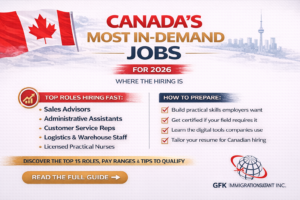
Canada’s Most In-Demand Jobs for 2026 — Where the Hiring Is
Canada’s job market for 2026 favors roles that keep businesses running day-to-day, move goods, protect financial accuracy, and deliver essential care. Employers increasingly value people who combine strong human skills with practical digital fluency — even in non-tech roles. The list below adapts the latest hiring snapshot into a clear guide: who’s hiring, why, what to expect in pay, and how you can prepare.
Why these jobs are hot in 2026
Four practical trends explain employer demand this year:
- Operations-first hiring: Companies invest in tools but still need reliable staff to run stores, schedules and customer touchpoints.
- Logistics growth: Warehousing, distribution and last-mile delivery are expanding, so operational roles (forklift operators, warehouse staff) are essential.
- Retail reshaped, not gone: Omnichannel retail needs staff who can blend in-store care with online order fulfilment and returns.
- Healthcare pressure: Ongoing care demand makes pharmacy assistants, LPNs and nurses a persistent priority.
Across these areas, employers prefer candidates who can use basic workplace tech (POS systems, scheduling and CRM tools) — “digital fluency” is a baseline skill today.
Canada’s top 15 in-demand jobs for 2026 (with what employers want)
Source data summary adapted from the latest hiring snapshot; salaries and role notes reflect national trends.
- Sales advisor — Frontline revenue drivers who combine product knowledge, customer care and POS skills. (Avg ≈ $72k / year as a national benchmark).
- Administrative assistant — Operational multipliers handling scheduling, bookkeeping basics and communication. (Avg ≈ $55k).
- Customer service representative — Problem-solvers across phone, chat and in-person channels. (Avg ≈ $54k).
- Accounting technician / Clerk — Day-to-day finance support: invoices, reconciliations and reporting. (Avg ≈ $53k).
- Receptionist — First contact role with scheduling and administrative responsibilities. (Avg ≈ $49k).
- Accountant — Core finance professionals handling payroll, reporting and audits. (Avg ≈ $59k).
- Shop assistant — Retail floor staff who support merchandising, transactions and customer care. (Avg ≈ $38k).
- Store manager — Operational leaders responsible for teams, budgets and targets. (Avg ≈ $73k).
- Pharmacy assistant — Pharmacy operations and inventory specialists supporting pharmacists. (Avg ≈ $47k).
- Licensed Practical Nurse (LPN) — Regulated, hands-on patient care providers (high local demand; licensing required). (Avg ≈ $46k).
- Dental assistant — Clinical administrative and chairside support (certification helps). (Avg ≈ $54k).
- Forklift operator / Warehouse worker — Logistics floor staff for distribution and fulfilment. (Salary varies by region).
- Light vehicle / delivery driver — Last-mile delivery drivers remain essential for e-commerce and logistics.
- Skilled trades (select areas) — Regionally important roles such as electricians, plumbers and HVAC techs.
- IT support / non-coding digital roles — Roles that ensure day-to-day systems run (helpdesk, admin for collaboration tools).
Note: salary figures are national averages reported in the data set and can vary by province, seniority and sector.
Growing sectors hiring in 2026
- Retail & customer experience — omnichannel operations, store leadership and floor staff.
- Logistics & distribution — warehouses, drivers and fulfilment specialists.
- Healthcare & dental services — regulated and support roles (LPNs, pharmacy/dental assistants).
- Finance & accounting — accounting technicians and accountants to keep compliance and reporting tidy.
- Technology support — workplace digital tools and helpdesk roles.
These sectors reward reliability, clear communication and a willingness to learn common workplace platforms (scheduling, POS, inventory and basic accounting tools).
How to compete: practical steps for jobseekers (including newcomers)
Most In-Demand Jobs in Canada 2026 — Top 15 Roles
- Match skills to job basics — many roles demand a mix of customer service, basic digital tools, and punctual, reliable attendance. Highlight those in your resume.
- Get certified where required — health care and some trades need provincial licences or formal certificates. Start credentialing early.
- Learn the tools employers use — short courses on POS systems, Excel basics, scheduling software or common CRM tools are high ROI.
- Localize your application — mention Canadian or provincial experience (even volunteer work), and include a Canada-formatted resume.
- Network in the community — reach out to local employers, temp agencies and settlement services (especially important for newcomers).
- Prepare for practical interviews — employers for these roles often test situational judgement and basic digital tasks (e.g., entering a transaction, resolving a customer query).
Advice for employers and hiring managers
- Simplify onboarding for frontline roles (clear checklists, buddy systems) to reduce early turnover.
- Invest in short skills training (POS, inventory software, basic financial tools) to increase internal promotion and retention.
- Consider flexible schedules and better pay bands to attract local candidates instead of relying solely on temporary labour.
SEO & GEO tips for GFK content editors
- Use location anchors: include city/province variants (e.g., “In-demand jobs in Toronto, Ontario”, “High-demand jobs in Alberta”) to capture geo search traffic.
- Long-tail keywords to target: “entry-level customer service jobs Canada 2026”, “how to become an LPN in Ontario 2026”, “warehouse jobs hiring now Toronto”.
- Add structured data (FAQ schema) for common queries like “what jobs are hiring in Canada 2026?” and “salary for licensed practical nurse Canada” to improve AEO performance.
Quick FAQs (good for on-page schema)
Q: Are these jobs open to newcomers?
A: Many frontline and operational roles are open to newcomers; regulated roles (LPN, dental assistant) require provincial licensing. Tailor your application and check licensing requirements early.
Q: Which provinces pay the most for these roles?
A: Pay varies by province and city. Urban centres (Toronto, Vancouver, Calgary) often have higher wages to offset living costs.
Q: Do I need Canadian experience?
A: Canadian experience helps but is not always required for entry roles. Strong references, volunteer work, or short-term temp placements can bridge the gap.
Final takeaway
For 2026, Canada’s labour demand is pragmatic: employers want people who show up reliably, communicate well, and use basic workplace tech confidently. If you’re a newcomer or jobseeker, focus on building the practical skills employers ask for — and target roles where quick credentialing or on-the-job training can speed your entry.
If you’d like, GFK Immigration Inc. can help you: tailor your resume for Canadian roles, find local training options, and navigate provincial licensing where needed. Book a consultation to map a clear, local job strategy.