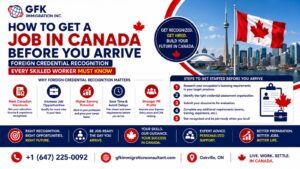
How to Get a Job in Canada Before You Arrive: Foreign Credential Recognition Every Skilled Worker Must Know
For many skilled immigrants, the biggest career challenge is not only finding a job in Canada, but finding the right job at the right time. The good news is that Canada already offers official tools and pre-arrival support to help newcomers prepare before they land. If you are serious about starting strong, your job search should begin before you arrive, not after. (Canada)
Why this matters
Many newcomers discover that the Canadian job market rewards preparation. Employers often want a Canadian-style application, a clear understanding of your occupation, and proof that you are eligible to work in your field. For regulated professions and compulsory trades, credential recognition and licensing may be required before you can practice. Canada’s official newcomer and pre-arrival services are designed to help with exactly these issues. (Canada)
1) How to get a job in Canada before you arrive
Start with Canada’s pre-arrival services
If you are approved for permanent residence and are still outside Canada, you may be eligible for free pre-arrival services. These services are meant to help you prepare for life and work in Canada before you arrive, including job search support and help with foreign credential recognition. (Canada)
Some pre-arrival programs can help you build job-search strategies, understand Canadian workplace culture, grow your professional network, and prepare for work in your field. That makes them one of the smartest first steps for skilled workers who want to reduce delay after landing. (Canada)
Use Job Bank early
The Government of Canada’s Job Bank is a free job-search platform that gives access to jobs across Canada, labour market information, career planning tools, and alerts for new openings. It is designed for job seekers, including newcomers. (Canada)
A practical approach is to use Job Bank before arrival to study job titles, salary patterns, job duties, and employment trends in your field. That helps you understand how your experience lines up with the Canadian market and where your skills may be in highest demand. (Canada)
Build a Canada-ready job application
Canada’s newcomer services point job seekers to resume and cover letter tips, job banks, and volunteer opportunities. That is a clear sign that a Canadian-style application matters. Your resume should be easy to scan, results-focused, and tailored to the role you want. Your cover letter should explain your value, not repeat your resume. (Canada)
Practical advice: before you apply, prepare three versions of your resume for the Canadian market. One should target your ideal role, one should target a nearby role you can qualify for faster, and one should target an entry point role that can help you get Canadian experience. That strategy improves your chances of getting interviews without wasting time. This is an inference based on the job-search and labour-market support tools Canada recommends for newcomers. (Canada)
Research employers before you land
Canada’s official job-search guidance recommends researching companies directly, checking their websites, attending job fairs, using job boards, and contacting employers. In other words, the earlier you start building a target list, the better your chances of moving quickly once you arrive. (Canada)
Practical advice: create a shortlist of 20 to 30 employers in your field, then track their hiring pages, recruitment emails, and preferred qualifications. Match your resume wording to the language used in their job postings. That simple step can improve relevance and help you pass the first screening stage. This is practical guidance based on how official job-search tools and employer search methods are structured. (Canada)
Prepare your documents now
Before arrival, gather and translate your important academic and professional documents so they are ready when needed. Canada’s newcomer guidance also emphasizes preparing documents before crossing the border, because missing documents can slow settlement and work preparation. (Canada)
Practical advice: keep digital and printed copies of your degree certificates, transcripts, reference letters, professional licenses, passport, and proof of employment history. Store them in one folder so you can quickly upload them for applications, assessments, or interviews. This recommendation follows directly from the document-preparation requirements and credential-recognition process described by Canada’s official sources. (Canada)
2) Foreign Credential Recognition: what every skilled worker must know
Foreign credential recognition is the process used to verify that your education, training, and work experience are equivalent to Canadian standards. For regulated occupations and compulsory trades, you usually need your credentials recognized and may also need a Canadian licence or certificate before you can work. (Canada)
This process can vary by occupation and by province or territory. That means there is no single national shortcut for everyone. The right move is to contact the regulatory authority for your occupation in the province or territory where you want to work, ideally before you arrive in Canada. (Canada)
Check whether your occupation is regulated
The official Foreign Credential Recognition Tool can help you check whether your profession or trade is regulated in the province or territory where you want to work, find the right regulatory body, and review career information such as salaries and job outlook. (Canada)
Practical advice: do this check before you submit job applications. Many skilled workers waste months applying for jobs they cannot legally perform yet. Knowing the licensing requirement early helps you choose the right employment path and avoid disappointment. This is a direct inference from the official requirement to confirm regulation and licensing before working in such roles. (Canada)
Expect time, cost, and extra steps
Canada’s official guidance says credential recognition can take time and can be costly. Depending on the occupation, you may need exams, additional training, tuition, or other fees. That is why planning early is essential. (Canada)
The Government of Canada also notes that Foreign Credential Recognition Loans of up to $30,000 may be available to help with related costs, along with support services such as career counselling, job readiness workshops, mentorship, and job search assistance. (Canada)
Do not wait until you land
One of the most important lessons for skilled workers is this: start the recognition process before arrival whenever possible. Canada’s own guidance says this is the best way to understand the specific requirements for your occupation and avoid unnecessary delays after landing. (Canada)
Practical action plan for skilled immigrants
- Register for pre-arrival services as soon as you are eligible. (Canada)
- Use Job Bank to study job titles, wages, and openings in your field. (Canada)
- Check whether your occupation is regulated in the province where you plan to live. (Canada)
- Contact the regulatory authority before you arrive. (Canada)
- Prepare translated copies of your credentials and work documents. (Canada)
- Build a Canadian-style resume and cover letter tailored to each role. (Canada)
- Research employers and apply strategically, not randomly. (Canada)
FAQ
Can I look for a job in Canada before arriving?
Yes. Canada provides pre-arrival support for eligible permanent residence applicants, and Job Bank gives access to Canadian job postings and labour-market information that can help you prepare before landing. (Canada)
Do all skilled workers need foreign credential recognition?
No. The requirement depends on the occupation and whether it is regulated in the province or territory where you want to work. Regulated professions and compulsory trades usually require credential recognition and licensing before you can practice. (Canada)
When should I start the process?
As early as possible, ideally before arriving in Canada. Official guidance says this helps you understand your requirements, costs, and timelines before you begin applying for jobs. (Canada)
Is Job Bank free?
Yes. Canada says Job Bank is free and trustworthy, with no hidden fees and no registration required. (Canada)
Final word
For skilled immigrants, success in Canada starts with preparation. The strongest job seekers are the ones who use official pre-arrival services, understand their credential requirements early, and build a job-search strategy before they step on the plane. That approach saves time, reduces stress, and improves your chances of landing the right opportunity faster. (Canada)
Disclaimer: This article is for educational purposes only and does not constitute legal, immigration, employment, or financial advice. Immigration rules, credential requirements, and labour-market conditions can change. Please verify all details with official Government of Canada sources, the relevant provincial or territorial regulatory authority, and a licensed professional before making any decision.
#GFKImmigration #CanadaImmigration #WorkInCanada #JobsInCanada #SkilledWorker #ExpressEntry #ForeignCredentialRecognition #NewToCanada #CanadianImmigration #CareerInCanada #MoveToCanada #CanadaPR #ImmigrationConsultant #CanadianJobs #ImmigrationSuccess #StudyWorkSettle #LifeInCanada #CanadaOpportunities #PermanentResidence #ImmigrateToCanada