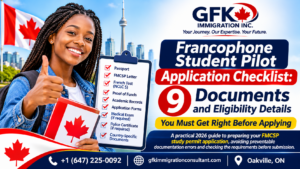
Francophone Student Pilot Application Checklist: 9 Documents and Eligibility Details You Must Get Right Before Applying
A practical 2026 guide to preparing your FMCSP study permit application, avoiding preventable documentation errors and checking the requirements before submission.
Getting admission to a Canadian college or university is an important milestone. But if you intend to apply through Canada’s Francophone Minority Communities Student Pilot (FMCSP), receiving an offer of admission is only one part of the process.
Your application must also demonstrate that you meet the pilot’s specific eligibility requirements. Your letter of acceptance must identify the FMCSP, your French language results must meet the required level in all four skills, and your financial and supporting documents must be consistent and complete.
A missing designation on your admission letter, an incorrect language-test assumption or unexplained funds can create avoidable complications.
So, what documents should you prepare before applying?
This guide explains nine important document categories and eligibility details to review before submitting your 2026 FMCSP study permit application.
Important: Not every document listed below is required in every case. Medical examinations, police certificates and certain country-specific documents depend on your circumstances and the instructions applicable to your application.
1. First, confirm that you are eligible for the FMCSP
Before collecting documents, establish whether you qualify for the programme.
To apply through the FMCSP, you must generally:
- Be a citizen of one of IRCC’s eligible countries.
- Have a letter of acceptance from a participating designated learning institution (DLI), identifying your application as an FMCSP application.
- Be accepted into a qualifying post-secondary programme.
- Demonstrate at least NCLC 5 in French speaking, listening, reading and writing.
- Have sufficient funds for tuition, living expenses and transportation.
- Be living outside Canada when you apply.
- Complete a medical examination and provide a police certificate if required.
Your programme must also be full-time, last at least two years, lead to a degree or diploma and have more than 50% of its classes taught in French.
Important distinction: Speaking French or living in a French-speaking country does not automatically make you eligible. The pilot has a specific citizenship requirement.
IRCC’s eligible countries include Benin, Burkina Faso, Burundi, Cabo Verde, Cameroon, Central African Republic, Chad, Comoros, Côte d’Ivoire, Democratic Republic of the Congo, Dominica, Republic of the Congo, Djibouti, Egypt, Equatorial Guinea, Gabon, Guinea, Guinea-Bissau, Haiti, Lebanon, Madagascar, Mali, Mauritania, Mauritius, Morocco, Niger, Rwanda, Saint Lucia, São Tomé and Principe, Senegal, Seychelles, Togo and Tunisia.
Nigeria is not currently on this list. However, a person living in Nigeria who holds citizenship of an eligible country may wish to have their individual circumstances assessed.
Check the official IRCC FMCSP eligibility requirements before proceeding.
2. The nine document categories to prepare
Document 1: Valid passport and proof of eligible citizenship
Your citizenship is one of the first eligibility conditions IRCC checks.
Prepare:
- A valid passport from your country of citizenship.
- Clear copies of the passport’s identification page.
- Relevant pages showing passport details, previous visas or travel history, where applicable.
- Additional citizenship evidence if requested by the visa office or applicable to your circumstances.
Common mistake: Assuming that residence, birthplace or French-speaking ability is enough to qualify.
For example, a person living in Cameroon who is not a Cameroonian citizen must establish whether they hold citizenship of another eligible country. The country of residence alone does not establish FMCSP eligibility.
Ensure that your passport details are consistent with the information on your application forms, admission documents and other supporting records.
Document 2: Letter of Acceptance (LOA) carrying the FMCSP designation
<mark>One of the most important documents in your application.</mark>
Your Letter of Acceptance must come from a participating designated learning institution.
However, an ordinary admission letter may not be sufficient for the FMCSP.
You must inform your institution that you intend to apply under the Francophone Minority Communities Student Pilot.
The institution must issue a letter that:
- Identifies the Francophone Minority Communities Student Pilot (FMCSP).
- States that you are applying under the pilot.
- Indicates that your programme meets the programme requirements.
- Confirms the relevant programme and admission details.
Before submitting your application, verify that the letter identifies the FMCSP and that the school and programme meet the pilot’s conditions.
Common mistake: Receiving admission from a designated learning institution and assuming that every programme at that institution automatically qualifies for the FMCSP.
A school being a DLI does not necessarily mean that every campus or programme is eligible for the pilot.
Check the official list of participating institutions.
Document 3: Approved French language test results
The FMCSP requires proof of French language proficiency at NCLC 5 or higher in each of the four language abilities:
- Speaking.
- Listening.
- Reading.
- Writing.
IRCC identifies two accepted tests for this requirement:
- Test d’évaluation de français (TEF Canada).
- Test de connaissance du français (TCF Canada).
Your results must demonstrate the required level in every skill.
For example, if your speaking, listening and reading results meet NCLC 5 but your writing result is below NCLC 5, you do not meet the language requirement based on those results.
A strong score in one skill cannot compensate for a score below the minimum in another.
Common mistakes:
- Submitting results from a test that is not accepted for the FMCSP language requirement.
- Checking only the overall score instead of all four abilities.
- Assuming that an intermediate or advanced French certificate automatically establishes NCLC 5.
- Uploading unclear or incomplete test-result documents.
- Ignoring the applicable test validity and result requirements.
Before applying, compare your actual test results with IRCC’s current approved equivalency requirements.
Document 4: Proof of financial capacity
Your financial evidence must demonstrate that you can afford your education and support yourself in Canada.
Under the FMCSP, you must demonstrate sufficient funds for:
- Your first year of tuition.
- Living expenses for yourself and accompanying family members.
- Transportation to and from Canada for yourself and accompanying family members.
You must also explain how you intend to finance the remaining period if your programme lasts longer than one year.
Depending on your circumstances, financial documents may include:
- Bank statements for the required period.
- Proof of a student or education loan.
- Scholarship or sponsorship documentation.
- A Guaranteed Investment Certificate (GIC), where applicable.
- Evidence of employment income.
- A financial support letter from a sponsor.
- Evidence of your relationship with the sponsor.
- Documents establishing the sponsor’s financial capacity.
- Proof of income from other legitimate sources.
IRCC specifically refers to bank statements for the previous six months, including the month of application or the month before, as one example of supporting evidence. It also requires documentation explaining the source of funds shown in those statements.
Common mistakes:
- Showing a large balance without explaining where the money came from.
- Using outdated financial thresholds.
- Ignoring accompanying family members.
- Providing a sponsor’s letter without evidence of the sponsor’s financial capacity.
- Demonstrating enough money for tuition but not living and transportation expenses.
Your financial documents should tell a clear and consistent story about the availability and source of your funds.
Document 5: Academic records and educational history
Your academic background helps establish your educational history and may be relevant to the institution’s admission assessment and the overall study permit application.
Prepare the documents requested by your institution and the applicable visa office, which may include:
- Previous academic certificates.
- Secondary school results.
- College or university transcripts.
- Diplomas and degrees.
- Professional qualifications, where relevant.
- Evidence of previous studies.
- Other academic records requested by the institution or IRCC.
Your academic records should be genuine, legible and consistent with the information in your application.
If you have gaps in your education or a significant change in your proposed field of study, prepare a clear explanation where appropriate.
Common mistake: Submitting incomplete academic records or failing to explain important differences between your previous education and your proposed programme.
Do not assume that every applicant needs exactly the same academic documents. Follow the institution’s admission requirements and the visa office instructions applicable to your country.
Document 6: Completed application forms and supporting information
Your study permit application must be completed accurately through the appropriate IRCC application process.
You should be ready to provide:
- The applicable study permit application information and forms.
- Personal and contact information.
- Passport and travel history.
- Educational history.
- Employment history, where requested.
- Family information.
- Background and admissibility information.
- Supporting explanations and declarations, where applicable.
Review every answer before submission.
Names, dates of birth, passport numbers, education history and family details should be consistent across your documents.
Common mistake: Rushing through application forms, leaving required questions unanswered or providing information that conflicts with the supporting documents.
If an answer requires an explanation, provide one that is factual, relevant and supported by evidence.
Document 7: Medical examination evidence, if required
A medical examination is not automatically required in every FMCSP application.
Depending on your circumstances, you may need an immigration medical examination if:
- You lived or travelled in certain countries or territories for six or more months during the year before coming to Canada.
- You intend to study or work in certain occupations or fields, including health services, primary or secondary education, or child or elder care.
If a medical examination is required, it must be completed with an IRCC-approved panel physician.
Follow the medical examination instructions applicable to your situation.
Common mistake: Assuming that a medical examination is unnecessary simply because you are applying as a student.
Check the IRCC medical examination requirements before submitting your application.
Document 8: Police certificate, if required
IRCC may require a police certificate depending on your circumstances and the visa office instructions for your country or region.
A police certificate may help establish that you meet Canada’s criminal admissibility requirements.
The exact requirements can vary depending on:
- Your country of citizenship.
- Your current country of residence.
- Previous countries where you lived.
- Your personal travel and residence history.
- The specific instructions issued by the relevant visa office.
Do not assume that a police certificate from your current country of residence is always sufficient.
Check the relevant visa office instructions to determine which certificates, if any, you need.
Common mistake: Waiting until the last minute to obtain a police certificate, especially where the issuing authority has lengthy processing times.
Document 9: Country-specific documents, translations and additional evidence
This is where applicants can overlook important requirements.
IRCC may request additional documents depending on the country or region from which you are applying.
These may include:
- Country-specific visa office checklists.
- Civil status documents.
- Birth certificates.
- Marriage certificates, where relevant.
- Employment or internship evidence, where requested.
- Additional academic records.
- Police or criminal-record documents.
- Proof of family relationships.
- Documents explaining gaps in education or employment.
- Other supporting documents specified in local instructions.
If a document is not in English or French, you must follow IRCC’s translation requirements. Depending on the circumstances, this may include a certified translation, a copy of the original document and an affidavit from the translator.
Do not assume that a document accepted in one country will automatically satisfy the requirements for an applicant applying from another country.
Practical advice: Select your country of citizenship and review the relevant instructions on the official IRCC application page.
3. Important: Do you need a Provincial Attestation Letter (PAL)?
This is a common question among international students.
No. You do not need a Provincial Attestation Letter (PAL) or Territorial Attestation Letter (TAL) when applying for a study permit through the FMCSP, provided you have a letter of acceptance from a participating school identifying you as an FMCSP applicant.
This exemption is specific to the pilot’s requirements.
Do not confuse the FMCSP exemption with the requirements that apply to other study permit categories.
Check the official IRCC PAL/TAL guidance.
4. What happens after you submit your application?
Preparing your documents is only one part of the process.
After submitting your application and paying the applicable fees, you may receive a biometrics instruction letter if biometrics are required.
You must follow the instructions in that letter and provide your fingerprints and photograph within the specified period.
IRCC may also:
- Verify your Letter of Acceptance with the participating institution.
- Review your language test results.
- Assess your financial evidence.
- Request additional documents.
- Request a medical examination, if required.
- Review your admissibility and background information.
- Request your passport or other information where necessary.
Submitting a complete application does not guarantee approval. IRCC makes the final decision after assessing your application.
For more information, visit IRCC’s FMCSP application process.
5. Ten common FMCSP application mistakes to avoid
Even applicants who meet the basic eligibility requirements can encounter problems when their supporting documents are incomplete or inconsistent.
Here are ten mistakes to watch for:
| No. | Common mistake | What to do instead |
|---|---|---|
| 1 | Applying with an ordinary admission letter that does not identify the FMCSP | Request an FMCSP-designated Letter of Acceptance from the participating school. |
| 2 | Choosing a school or programme that does not qualify | Verify the institution, campus and programme against IRCC’s official list and requirements. |
| 3 | Assuming French-speaking ability alone is enough | Confirm that you hold citizenship of an eligible country. |
| 4 | Submitting French test results below NCLC 5 in one skill | Check speaking, listening, reading and writing separately. |
| 5 | Providing insufficient proof of funds | Include tuition, living expenses, travel costs and accompanying family members. |
| 6 | Failing to explain large or recent bank deposits | Provide credible evidence of the source and availability of funds. |
| 7 | Ignoring country-specific visa office instructions | Check the instructions for your country or region before submitting. |
| 8 | Overlooking medical or police certificate requirements | Determine whether either document is required for your circumstances. |
| 9 | Uploading incomplete or poorly translated documents | Check document quality, translation requirements and supporting evidence. |
| 10 | Providing inconsistent information across forms and documents | Cross-check personal, academic, financial and family details before submission. |
The best way to avoid these errors is to conduct a document review before submitting your application.
6. FMCSP application checklist: Review your documents before submission
Use this checklist as a preparation tool. It is not a substitute for the personalised document checklist generated through IRCC’s application process or the visa office instructions for your country.
Eligibility and admission
-
I hold citizenship of an FMCSP-eligible country.
-
I am applying from outside Canada.
-
My institution is listed as a participating DLI.
-
My programme is post-secondary and full-time.
-
My programme lasts at least two years.
-
My programme leads to a degree or diploma.
-
More than 50% of the classes are taught in French.
-
My Letter of Acceptance identifies the FMCSP.
Language and finances
-
I have an accepted TEF Canada or TCF Canada result.
-
My speaking result meets NCLC 5 or higher.
-
My listening result meets NCLC 5 or higher.
-
My reading result meets NCLC 5 or higher.
-
My writing result meets NCLC 5 or higher.
-
I have evidence of sufficient funds for tuition.
-
I have evidence of sufficient living expenses.
-
I have budgeted for transportation.
-
I have accounted for accompanying family members.
-
I can explain how I will finance the remaining period of study.
Supporting documents and final checks
-
My passport details are correct and consistent.
-
My academic records are complete.
-
My application forms are accurately completed.
-
I have checked whether a medical examination is required.
-
I have checked whether a police certificate is required.
-
I have reviewed my country-specific visa office instructions.
-
My translations meet IRCC requirements.
-
I have checked whether additional documents are required.
-
I have confirmed the PAL/TAL exemption applies to my FMCSP application.
-
I have reviewed all uploaded documents before submission.
7. How GFK Immigration Inc. can help you avoid preventable application errors
A successful application starts with more than collecting documents. It requires understanding which documents apply to your circumstances, checking that they meet the relevant requirements and ensuring that the information is consistent.
At GFK Immigration Inc., we can help you review your FMCSP application preparation, identify potential documentation gaps and understand the requirements before submission.
Our document review can cover:
- Eligibility assessment: Review your citizenship, proposed programme and other FMCSP eligibility conditions.
- Admission letter verification: Check whether your Letter of Acceptance carries the appropriate FMCSP designation.
- French language review: Examine your TEF Canada or TCF Canada results across all four language abilities.
- Financial evidence review: Assess your proof of funds, source of funds and financial planning.
- Academic documentation: Review your educational records and supporting documents.
- Country-specific requirements: Identify relevant visa office instructions and additional documentation.
- Medical and police requirements: Help you understand whether these documents may be required.
- Application consistency: Identify discrepancies, missing information and potential weaknesses in your supporting documents.
Our goal is to help you approach your application with better preparation and a clearer understanding of the requirements.
Frequently Asked Questions (FAQs)
1. What is the most important document for an FMCSP application?
The Letter of Acceptance from a participating DLI is a critical document. It must identify the applicant as applying under the Francophone Minority Communities Student Pilot and indicate that the programme meets the pilot’s requirements. However, the letter alone does not establish eligibility or guarantee approval.
2. Can I apply through the FMCSP with an ordinary Canadian college admission letter?
Not without checking and correcting the letter. Your institution must know that you intend to apply through the FMCSP and issue a letter that identifies the pilot and confirms the qualifying programme details.
3. Which French tests are accepted for the FMCSP?
IRCC identifies TEF Canada and TCF Canada as the approved French language tests for this pilot. You must demonstrate at least NCLC 5 in speaking, listening, reading and writing.
4. Do I need NCLC 5 in all four French language skills?
Yes. Each of the four abilities must independently meet NCLC 5 or higher. A higher result in one skill cannot compensate for a result below the minimum in another.
5. Do I need a Provincial Attestation Letter (PAL) for the FMCSP?
No. Applicants with a Letter of Acceptance from a participating school identifying them as FMCSP applicants are exempt from the PAL/TAL requirement for this pilot.
6. Is a medical examination compulsory for every FMCSP applicant?
No. Medical examination requirements depend on factors such as your residence or travel history and your intended field of study or work. Follow IRCC’s instructions for your individual circumstances.
7. Must every applicant submit a police certificate?
No. IRCC indicates that police certificates may be required depending on the visa office instructions and the applicant’s circumstances. Check the instructions for your country or region.
8. Can I use my parents’ bank statements as proof of funds?
Financial support from another person may be accepted when properly documented. You may need to provide a support letter, evidence of the sponsor’s employment or financial capacity, proof of your relationship and evidence of the funds available to you.
9. Are country-specific documents required for every applicant?
Not necessarily. Additional documents depend on your country or region, personal circumstances and the instructions applicable to your application. Always check the relevant IRCC visa office instructions.
10. Does submitting every required document guarantee approval?
No. A complete document package does not guarantee approval. IRCC assesses eligibility, admissibility, the credibility of the information provided and all other applicable requirements before making a decision.
Final thoughts: Prepare your documents before you apply
The Francophone Minority Communities Student Pilot offers eligible French-speaking international students an opportunity to study at participating institutions outside Quebec.
However, your application must demonstrate that you satisfy the programme’s citizenship, language, admission and financial requirements.
The most important preparation step is to ensure that your documents tell a consistent and credible story.
Your Letter of Acceptance must carry the FMCSP designation. Your French language results must meet NCLC 5 in all four skills. Your financial evidence must demonstrate sufficient available funds. Your medical, police and country-specific documents must follow the instructions that apply to you.
Do not let a preventable documentation error weaken an otherwise promising application.
Avoid preventable application errors. Request a professional document review.
Planning to apply through the Francophone Student Pilot?
Let GFK Immigration Inc. help you review your eligibility, identify missing documents and understand the requirements before you submit your application.
📞 Call/WhatsApp: +1 (647) 225-0092
🌐 Website: https://gfkimmigrationconsultant.com
📍 Location: Oakville, Ontario, Canada
GFK Immigration Inc. — YOUR JOURNEY. OUR EXPERTISE. YOUR FUTURE.
Disclaimer: This article is for general information and educational purposes only. Immigration requirements and visa office instructions may change. The checklist is a planning aid and does not replace the personalised document checklist or instructions issued by IRCC. No application outcome is guaranteed. IRCC makes the final decision on all applications.