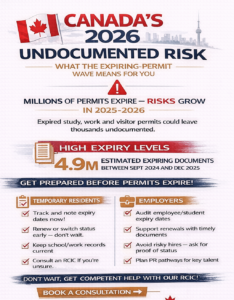
Canada’s 2026 Undocumented Risk — What the Expiring-Permit Wave Means for You
Canada is entering a high-volume period of expiring temporary immigration documents — and that creates two uncomfortable realities: large administrative workload for authorities, and heightened risk that some people will remain without valid status. Policymakers are debating how big the “undocumented” problem could grow in 2026; the short answer is this: the data are imperfect, the scale is large, and small non-compliance rates across millions of expiries can produce big effects.
Below you’ll find a clear, practical walkthrough of the numbers, what they don’t mean, enforcement realities, and concrete actions for temporary residents and employers.
The headline numbers — what the “4.9 million” figure really is
Parliamentary testimony and departmental briefings flagged up to 4.9 million expiring immigration documents between September 2024 and December 2025. Importantly, that count refers to documents (visas, permits, letters), not 4.9 million unique people — one person can hold multiple documents. But even as an administrative load indicator, the number signals a heavy workload for IRCC and border agencies.
Why that matters: when a system processes millions of expiries, even a small percentage of people who don’t renew, depart, or change status translates to a large absolute number of people without authorization — and that’s the core of the “undocumented risk.”
Canada’s exit-data gap — the measurement problem
Canada doesn’t maintain a complete, person-level public system that reconciles permit expiries with verified exits. Federal officials have repeatedly said they don’t have a single, auditable number showing who left and who stayed after permits expired. That gap turns what should be a precise administrative question into a matter of probabilities and projections.
Because of that measurement gap, policy debates often compare worst-case projections with optimistic compliance assumptions — and that fuels political uncertainty even when the underlying evidence is limited.
What the data suggest about undocumented presence
Official and expert estimates vary, but recent briefings and analyses suggest there were hundreds of thousands of undocumented residents in Canada prior to 2026 — with some government briefings flagging figures on the order of ~500,000 (estimates vary by methodology and are treated with caution). Projections made during the 2025–2026 permit expiry wave indicate the potential for this number to rise significantly if renewals, transitions to PR, or departures don’t keep pace with expiries.
A few things to watch:
- Geographic concentration: major cities such as Toronto, Vancouver and Montreal are likely to host the largest shares of any undocumented population due to large temporary-resident populations.
- Demographic patterns: some analyses point to particular national cohorts and sectors (e.g., certain student or work-permit groups) as being higher-risk for falling out of status.
Enforcement reality — removals are rising but limited by scale
Enforced removals by the Canada Border Services Agency (CBSA) rose in 2025 (e.g., nearly 18,785 removals year-to-date through Oct. 31, 2025), but even growing removal numbers are small relative to the size of the temporary-resident population and the volume of expiries. That means enforcement alone cannot be the main tool to resolve mass expiries.
Practical implication: enforcement is important and will increase in targeted areas (fraud networks, repeat non-compliance), but governments must pair enforcement with prevention, better data, and transition pathways.
Four practical policy levers for 2026 (what Ottawa can do)
Policy experts highlight four strategic levers that are more effective than blunt enforcement:
- Build reconciled exit/status data — accurate, person-level reconciliation of expiries and exits lets agencies target resources where they matter most.
- Earlier compliance detection — faster checks on high-risk streams (some schools, short-term work sectors) can stop drift before it becomes an overstay.
- Credible transition pathways — create and scale renewal or conversion lanes for the workers and graduates Canada wants to retain (priority occupations, skilled graduates).
- Targeted, intelligence-led enforcement — focus CBSA resources on fraud, criminal networks and repeat offenders rather than trying to remove large numbers of otherwise compliant people.
What temporary residents should do now (practical checklist)
If you hold a study permit, work permit, visitor record, or other temporary document, follow these steps to reduce your risk of falling out of status:
- Track expiry dates carefully. Put reminders at least 90 and 30 days before expiry.
- Act early — submit extension or status-change applications well before expiry whenever you’re eligible. Don’t wait for the last week.
- Keep documentation current — proof of employment, school enrolment letters, payslips, and address records will help you demonstrate compliance.
- Seek advice if your situation is complex — refused applications or overlapping statuses need professional guidance to avoid cascading problems.
- If you’re unsure about eligibility to remain or switch categories, book a licensed RCIC consultation.
These steps are practical, inexpensive, and the most effective way to remain compliant in a tightening policy environment.
What employers and institutions should do
Employers and education providers play a central role in preventing status drift. Key actions include:
- Audit employee/student expiry timelines and build internal alerts.
- Support renewals by providing timely employment letters or enrolment confirmations.
- Avoid risky hires where documentation is unclear — seek advice when in doubt.
- Consider longer-term talent solutions (PNP sponsorships, employer-specific work permits, permanent-residency pathways) to reduce churn and legal risk.
Proactive employer practices reduce operational risk and help communities avoid the social fallout of undocumented populations.
Bottom line — prepare, don’t panic
The expiring-permits wave is a real administrative and policy challenge. The evidence points to large volumes and real integrity issues — but it also shows clear policy options that reduce undocumented risk: better data, early detection, credible transition options, and targeted enforcement. For individuals and employers, the best response is simple: track expiry dates, act early, and get professional help when your case is complex.
Need help? Book an RCIC-led review
If your status is expiring, you have overlapping applications, or you employ temporary workers, GFK Immigration Inc. can help with practical, RCIC-led advice and fast, actionable plans.
Gboyega Esan — RCIC R708591
📞 +1 (647) 225-0092
✉️ gfkimmigrationconsultant@gmail.com
🌐 gfkimmigrationconsultant.com
Sources: recent parliamentary testimony and IRCC/CBSA briefings and statistics on expiring permits, temporary resident counts, and removals.