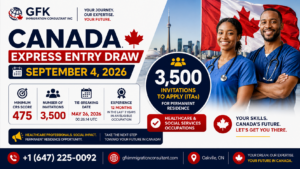
Canada Express Entry Draw September 4, 2026: IRCC Invites 3,500 Healthcare and Social Services Workers
Canada has issued 3,500 Invitations to Apply (ITAs) for permanent residence in the latest Express Entry draw, giving eligible healthcare and social services professionals another opportunity to pursue Canadian permanent residence.
Immigration, Refugees and Citizenship Canada (IRCC) conducted a category-based Express Entry draw on September 4, 2026, targeting candidates with eligible work experience in healthcare and social services occupations.
The draw issued 3,500 ITAs and had a minimum Comprehensive Ranking System (CRS) score of 475. Candidates who had a CRS score of 475 needed to meet the applicable tie-breaking rule to receive an invitation.
For prospective immigrants working in healthcare, social services and related occupations, the draw highlights the importance of understanding Express Entry category-based selection, rather than relying solely on general or Canadian Experience Class (CEC) draws.
September 4, 2026 Express Entry Draw Results
Here are the key details of the latest draw:
| Draw Detail | September 4, 2026 Result |
|---|---|
| Draw type | Healthcare and Social Services Occupations |
| Number of ITAs issued | 3,500 |
| Lowest CRS score invited | 475 |
| Draw date | September 4, 2026 |
| Draw time | 11:16:45 UTC |
| Rank required | 3,500 or above |
| Tie-breaking date | May 26, 2026 |
| Tie-breaking time | 00:26:14 UTC |
IRCC’s Express Entry system ranks eligible candidates according to their CRS scores, with category-based draws allowing the department to target candidates who meet specific economic or labour-market objectives.
Why the CRS 475 Cut-Off Matters
The CRS 475 cut-off is particularly important because it was substantially lower than the 521 CRS cut-off in the September 1 Canadian Experience Class draw.
That difference demonstrates why category-based selection can be important for candidates whose occupations fall within an IRCC priority category.
A candidate may have a CRS score that is not competitive enough for a particular CEC draw but could still receive an ITA through a category-based draw if they satisfy the relevant category requirements.
However, a CRS score of 475 does not mean every healthcare or social services candidate with 475 points will automatically receive an ITA. Candidates must meet the eligibility requirements for the specific round, and the tie-breaking rule may determine which candidates at the cut-off score receive invitations.
Who Qualifies for the Healthcare and Social Services Category?
IRCC’s current eligibility requirements state that candidates must have accumulated at least 12 months of full-time work experience, or an equivalent amount of part-time experience, within the previous three years.
The experience:
- Must be in one eligible occupation.
- Does not need to be continuous.
- Can have been obtained inside or outside Canada.
- Must satisfy the requirements specified for the particular Express Entry round.
Candidates must also qualify for at least one of the three immigration programs managed through Express Entry: the Federal Skilled Worker Program, Canadian Experience Class or Federal Skilled Trades Program.
Importantly, meeting the occupation requirement alone does not guarantee an invitation.
Healthcare and Social Services Occupations Included
IRCC’s current healthcare and social services category includes a broad range of occupations rather than only doctors and nurses.
Examples include:
Healthcare professionals
- General practitioners and family physicians
- Specialists in clinical and laboratory medicine
- Specialists in surgery
- Dentists
- Pharmacists
- Psychologists
- Chiropractors
- Physiotherapists
- Occupational therapists
- Optometrists
- Audiologists and speech-language pathologists
- Dietitians and nutritionists
Nursing and medical occupations
- Registered nurses and registered psychiatric nurses
- Nurse practitioners
- Nursing coordinators and supervisors
- Licensed practical nurses
- Paramedical occupations
- Respiratory therapists
- Medical laboratory technologists
- Medical radiation technologists
- Medical sonographers
- Pharmacy technicians
Social services occupations
- Social workers
- Social and community service workers
- Therapists in counselling and related specialized therapies
The complete category currently contains 37 eligible occupations under the listed NOC codes.
Does Healthcare Work Experience Have to Be Canadian?
No.
For the current Healthcare and Social Services Occupations category, IRCC states that the required work experience can be acquired in Canada or abroad.
This is an important distinction for internationally trained healthcare professionals who are considering Canadian permanent residence.
However, candidates must still satisfy the other Express Entry and category-specific requirements applicable to the draw.
How the September 4 Draw Compares With Recent Express Entry Draws
The September 4 healthcare draw came during a particularly active period for Express Entry.
Recent rounds included:
| Date | Draw Category | ITAs | CRS Cut-Off |
|---|---|---|---|
| September 4, 2026 | Healthcare & Social Services | 3,500 | 475 |
| September 3, 2026 | Physicians with Canadian Work Experience | 229 | 198 |
| September 1, 2026 | Canadian Experience Class | 2,000 | 521 |
| August 31, 2026 | Provincial Nominee Program | 562 | 697 |
The sequence illustrates how different Express Entry rounds can produce dramatically different CRS thresholds because each draw targets a different pool of eligible candidates.
What Is the Tie-Breaking Rule?
The tie-breaking rule becomes important when IRCC reaches the same CRS score among more candidates than there are available invitations.
For the September 4 draw, the tie-breaking timestamp was:
May 26, 2026 at 00:26:14 UTC.
Therefore, candidates with a CRS score of exactly 475 needed to have submitted their Express Entry profiles before that timestamp to be selected in the draw.
The tie-breaking rule does not lower the CRS requirement. Instead, it determines which candidates at the lowest invited score receive an invitation when there are more candidates at that score than available ITAs.
What If Your CRS Score Is Below 475?
If you work in an eligible healthcare or social services occupation but your CRS score is below 475, this draw does not mean your Canadian immigration plans are over.
Instead, consider whether you can legitimately improve your CRS score through factors such as:
- Improving your English or French language results
- Obtaining additional eligible education
- Gaining additional qualifying work experience
- Exploring eligible provincial nomination opportunities
- Reviewing whether you qualify for another Express Entry category
- Keeping your Express Entry profile accurate and up to date
Candidates should avoid making changes solely because they expect a particular CRS cut-off in a future draw. IRCC does not guarantee future draw sizes, categories or CRS thresholds.
What If You Received an Invitation to Apply?
If you received an ITA in the September 4 Express Entry draw, the next step is to review your invitation and prepare your permanent residence application carefully.
IRCC states that candidates who receive an ITA have 60 days to submit their permanent residence application.
Your personalized document requirements may vary depending on your circumstances and the Express Entry program through which you qualify.
Documents may include items such as:
- Passport and identity documents
- Language test results
- Police certificates
- Proof of work experience
- Educational documents
- Proof of settlement funds, where applicable
- Medical examination documentation
- Other supporting documents requested by IRCC
Healthcare professionals should also distinguish between immigration eligibility and professional licensing. Receiving Canadian permanent residence does not automatically grant authorization to practise a regulated healthcare profession in a particular province.
What This Draw Means for Healthcare Professionals
The September 4 draw reinforces an important development in Canada’s Express Entry system: occupation-specific selection can create opportunities for candidates who may not be competitive in other draw types.
For healthcare and social services professionals, the strategy should therefore go beyond simply asking:
“What is my CRS score?”
A better question is:
“Which Express Entry categories can I legitimately qualify for, and how competitive is my profile within those categories?”
IRCC explains that category-based selection is designed to identify candidates who meet specific economic objectives, including candidates with experience in selected occupations or specific language abilities.
Is There a Guaranteed CRS Score for the Next Healthcare Draw?
No.
IRCC does not guarantee a specific CRS cut-off for future Express Entry draws.
The number of invitations, eligible candidates in the pool and other factors can influence the final CRS threshold.
The September 4 draw therefore should be viewed as a snapshot of the current Express Entry environment, not a promise that the next healthcare draw will also have a CRS cut-off of 475.
Frequently Asked Questions
What was the CRS score for the September 4, 2026 Express Entry draw?
The minimum CRS score was 475 for the Healthcare and Social Services Occupations category.
How many invitations did IRCC issue on September 4, 2026?
IRCC issued 3,500 Invitations to Apply for permanent residence.
Was the September 4 draw a CEC draw?
No. It was a category-based draw targeting Healthcare and Social Services Occupations.
Can healthcare workers outside Canada qualify?
Yes. For the current healthcare and social services category, the required qualifying work experience can be obtained in Canada or abroad.
Do I need Canadian healthcare work experience?
Not necessarily for the Healthcare and Social Services category. IRCC allows the required category work experience to be obtained in Canada or abroad. Other Express Entry program requirements still apply.
What happens if my CRS score is 475?
A CRS score of 475 alone does not guarantee an ITA. For the September 4 draw, candidates at 475 also had to satisfy the tie-breaking rule, including having submitted their profile before May 26, 2026 at 00:26:14 UTC.
How long do I have to apply after receiving an ITA?
IRCC gives invited candidates 60 days to submit their permanent residence application.
Final Takeaway
The September 4, 2026 Express Entry draw delivered a significant opportunity for eligible healthcare and social services professionals, with 3,500 ITAs issued at a CRS cut-off of 475.
For candidates in eligible occupations, the result highlights the potential value of category-based Express Entry selection.
But the right strategy is not to wait for another low CRS draw. Candidates should understand their eligibility, calculate their current CRS score accurately, identify every category they may qualify for and strengthen their profile where possible.
Your CRS score is only one part of your Canadian immigration strategy.
If you’re unsure whether your occupation, work experience, CRS score or Express Entry profile puts you in a strong position, professional assessment can help you make a more informed decision.
Planning your pathway to Canadian permanent residence?
GFK Immigration Inc. can help you assess your immigration options and understand the requirements that apply to your individual circumstances.
📞 +1 (647) 225-0092
🌐 GFK Immigration Consultant – Helping you on your immigration journey to make Canada home.
📍 Oakville, Ontario
#ExpressEntry #CanadaPR #HealthcareJobs #SocialServices #CRS #CanadaImmigration #GFKImmigration