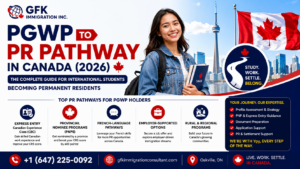
PGWP to PR Pathway in Canada (2026): The Complete Guide for International Students Becoming Permanent Residents
For thousands of international students, graduating from a Canadian institution is only the beginning. The real objective is often to secure Canadian Permanent Residence (PR) and build a long-term future in Canada.
In 2026, however, the journey from a Post-Graduation Work Permit (PGWP) to Permanent Residence has become more competitive. Higher Comprehensive Ranking System (CRS) scores, changing immigration priorities, and evolving Provincial Nominee Programs (PNPs) mean applicants need a well-planned strategy instead of relying on a single pathway.
This guide explains the most effective PGWP-to-PR options available today and how to improve your chances of receiving an Invitation to Apply (ITA).
What is a Post-Graduation Work Permit (PGWP)?
A Post-Graduation Work Permit (PGWP) is an open work permit that allows eligible graduates from designated Canadian post-secondary institutions to gain valuable Canadian work experience after completing their studies.
Canadian work experience earned under a PGWP can significantly strengthen an immigration profile and may qualify graduates for several permanent residence programs.
Why Is the PGWP-to-PR Journey More Competitive in 2026?
PGWP to PR Pathway in Canada (2026)
Canada continues to welcome skilled immigrants, but immigration has become more targeted.
Some of the biggest challenges include:
- Higher CRS cut-off scores in many Express Entry draws
- Increased competition among international graduates
- Provincial programs focusing on occupations facing labour shortages
- Greater emphasis on French-language proficiency and category-based selection
- Growing importance of employer support and regional immigration streams
The good news is that several pathways remain available for qualified candidates.
1. Express Entry (Canadian Experience Class)
The Canadian Experience Class (CEC) remains one of the most popular pathways for PGWP holders.
You may qualify if you:
- Have at least one year of skilled Canadian work experience
- Meet the required language proficiency
- Create an Express Entry profile
- Obtain a competitive CRS score
Recent CEC draws have required relatively high CRS scores, making profile optimization increasingly important.
2. Provincial Nominee Programs (PNPs)
Many provinces actively recruit international graduates to fill local labour shortages.
Popular destinations include:
- Ontario
- British Columbia
- Alberta
- Saskatchewan
- Manitoba
- Nova Scotia
Receiving a provincial nomination adds 600 CRS points, virtually guaranteeing an Invitation to Apply under Express Entry-linked streams.
Each province has different eligibility requirements based on:
- Occupation
- Education
- Job offer
- Employer support
- Regional labour needs
3. French-Language Immigration Pathways
French-speaking graduates now enjoy additional opportunities.
Applicants with strong French proficiency may qualify for:
- French-language Express Entry category-based draws
- Francophone immigration initiatives
- Provincial Francophone streams
Canada continues expanding programs that attract French-speaking newcomers outside Quebec.
4. Employer-Supported Immigration
Many PGWP holders become eligible for permanent residence through employer-supported programs.
This may include:
- Provincial employer streams
- Express Entry with arranged employment (where applicable)
- Occupation-specific immigration pathways
Maintaining stable, skilled employment can significantly strengthen an immigration application.
5. Rural and Regional Immigration Programs
Canada continues encouraging newcomers to settle outside major cities.
Some communities offer dedicated immigration pathways for workers in sectors experiencing labour shortages.
Benefits may include:
- Lower competition
- Employer support
- Faster access to permanent residence
- Strong community integration
Availability depends on participating communities and current program requirements.
6. Family Sponsorship
If your spouse or partner is a Canadian citizen or permanent resident, you may qualify for Family Class sponsorship.
Eligibility depends on your relationship and meeting IRCC’s sponsorship requirements.
How to Increase Your CRS Score
PGWP to PR Pathway in Canada (2026)
Improving your CRS score can dramatically increase your chances of receiving an Invitation to Apply.
Consider:
- Improving IELTS or CELPIP scores
- Taking an approved French language test
- Gaining additional skilled Canadian work experience
- Completing another eligible Canadian credential
- Securing a Provincial Nomination
- Including your spouse’s qualifications where applicable
- Keeping your Express Entry profile updated
Common Mistakes to Avoid
Many graduates unintentionally reduce their immigration options by:
- Waiting until their PGWP is close to expiring
- Missing language test expiry dates
- Failing to maintain valid status
- Ignoring provincial nomination opportunities
- Assuming PR is automatic after graduation
- Not seeking guidance when immigration rules change
Planning early can help avoid unnecessary delays or missed opportunities.
Additional 2026 Updates for International Students
International students should also stay informed about recent IRCC changes.
For example:
- Eligible post-secondary students no longer require a separate co-op work permit for mandatory work placements, simplifying the study process.
- Certain temporary public policies continue to support eligible applicants, including extensions for specific open work permit programs.
Because immigration policies evolve frequently, reviewing the latest IRCC updates before applying is essential.
Final Thoughts
PGWP to PR Pathway in Canada (2026)
The pathway from PGWP to Canadian Permanent Residence remains achievable—but success in 2026 requires planning, preparation, and a strategy tailored to your profile.
Whether your best option is Express Entry, a Provincial Nominee Program, French-language immigration, or an employer-supported pathway, understanding your eligibility early can significantly improve your chances of becoming a Canadian permanent resident.
Frequently Asked Questions (FAQs)
Is a PGWP a direct pathway to Permanent Residence?
No. A PGWP is a temporary work permit that helps graduates gain Canadian work experience, which may qualify them for several PR programs.
What is the easiest PR pathway after a PGWP?
There is no single “easiest” route. The best option depends on your education, occupation, work experience, language scores, and the province where you live or work.
Can I apply for PR while holding a PGWP?
Yes. Many international graduates submit their PR applications while working under a valid Post-Graduation Work Permit.
Do I need a job offer for PR?
Not always. Some immigration pathways do not require a job offer, while others—including many Provincial Nominee Programs—may.
Is Canadian work experience important?
Yes. Skilled Canadian work experience remains one of the strongest factors for qualifying under several economic immigration programs.
Contact our team today for personalized advice and professional immigration support.
 Phone: +1 (647) 225-0092
 Website: gfkimmigrationconsultant.com
 Location: Oakville, Ontario, Canada
Disclaimer: This article is for general educational and informational purposes only and does not constitute legal or immigration advice. Canadian immigration policies and eligibility requirements may change without notice. For personalized guidance based on your unique circumstances, consult a licensed immigration professional before making any immigration decisions.