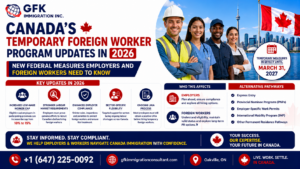
Canada’s Temporary Foreign Worker Program Updates in 2026: New Federal Measures Employers and Foreign Workers Need to Know
Canada continues to rely on the Temporary Foreign Worker Program (TFWP) to address genuine labour shortages across key industries. However, to balance workforce needs with opportunities for Canadians and permanent residents, the Government of Canada has introduced several temporary measures affecting employers, foreign workers, and Labour Market Impact Assessment (LMIA) applications.
If you are planning to hire international talent or work temporarily in Canada, understanding these changes is essential.
At GFK Immigration Inc., we closely monitor updates from Employment and Social Development Canada (ESDC) and Immigration, Refugees and Citizenship Canada (IRCC) to help employers and foreign nationals make informed immigration decisions.
What Is the Temporary Foreign Worker Program (TFWP)?
The Temporary Foreign Worker Program allows Canadian employers to hire foreign nationals when qualified Canadian citizens or permanent residents are not available to fill labour shortages.
Before hiring through most TFWP streams, employers must obtain a positive Labour Market Impact Assessment (LMIA) demonstrating that employing a foreign worker will not negatively affect Canada’s labour market.
The program supports industries such as:
- Agriculture
- Healthcare
- Hospitality
- Construction
- Manufacturing
- Transportation
- Food processing
- Tourism
Why Has Canada Introduced Temporary Measures?
The federal government continues to adjust the TFWP in response to changing economic conditions, labour shortages, and unemployment rates across different regions.
The 2026 temporary measures aim to:
- Address labour shortages in eligible communities
- Protect employment opportunities for Canadians
- Strengthen employer compliance
- Improve program integrity
- Ensure responsible use of temporary foreign labour
These measures are time-limited and may be revised as labour market conditions evolve.
Key Temporary Foreign Worker Program Updates for 2026
1. Increased Low-Wage Worker Cap for Eligible Rural Employers
One of the most significant temporary measures allows participating provinces and territories to increase the cap on low-wage Temporary Foreign Workers for eligible employers located outside Census Metropolitan Areas (CMAs).
For participating jurisdictions:
- The maximum low-wage workforce cap may increase from 10% to 15%.
- The measure is intended to help employers experiencing ongoing labour shortages in rural communities.
- The temporary policy is currently scheduled to remain in effect until March 31, 2027.
Not every province has chosen to participate, so employers should verify the rules that apply in their province before submitting an LMIA application.
2. Enhanced Labour Market Requirements
Employers must continue demonstrating that they have made genuine efforts to recruit Canadian citizens and permanent residents before seeking approval to hire temporary foreign workers.
Recruitment records, advertising requirements, and wage obligations remain important parts of the LMIA process.
3. Stronger Employer Compliance
The federal government continues to strengthen employer compliance measures to protect foreign workers and maintain public confidence in the immigration system.
Employers are expected to:
- Pay the approved wage
- Maintain safe working conditions
- Respect employment standards
- Meet housing obligations where applicable
- Cooperate with inspections conducted by government authorities
Failure to comply may result in financial penalties, suspension from the program, or future hiring restrictions.
4. Sector-Specific Flexibility
Some sectors continue receiving targeted support due to persistent labour shortages.
Agriculture, food production, healthcare, and certain seasonal industries remain among the sectors where foreign workers play an essential role in maintaining Canada’s economy.
Eligibility requirements vary depending on the stream and occupation.
5. Ongoing LMIA Processing
Most employers hiring through the Temporary Foreign Worker Program must continue obtaining an approved Labour Market Impact Assessment before a worker can apply for a work permit.
LMIA applications are assessed based on several factors, including:
- Labour shortages
- Recruitment efforts
- Wage levels
- Working conditions
- Regional labour market needs
Processing times may vary depending on the occupation, location, and application volume.
What These Changes Mean for Employers
Canadas Temporary Foreign Worker Program Updates
Employers should:
- Stay updated on provincial participation in temporary measures.
- Plan recruitment well in advance.
- Ensure LMIA applications are complete and accurate.
- Maintain compliance with all employment standards.
- Consider alternative immigration pathways where appropriate.
Working with an experienced immigration consultant can help reduce delays and improve application quality.
What These Changes Mean for Temporary Foreign Workers
For foreign workers, these temporary measures do not eliminate opportunities to work in Canada.
However, applicants should:
- Confirm that prospective employers meet TFWP requirements.
- Ensure work permits are tied to approved LMIA applications where required.
- Maintain valid immigration status.
- Understand the conditions attached to their work permits.
Those seeking long-term settlement may also wish to explore permanent residence pathways through Express Entry or Provincial Nominee Programs (PNPs).
Alternative Immigration Pathways
Canadas Temporary Foreign Worker Program Updates
Depending on your circumstances, you may qualify for:
- Express Entry
- Provincial Nominee Programs (PNPs)
- Atlantic Immigration Program
- Rural Community Immigration pathways
- International Mobility Program (IMP)
- Employer-specific work permits
- Open work permits (where eligible)
Choosing the right pathway depends on your occupation, qualifications, work experience, and immigration goals.
Frequently Asked Questions
Do all employers qualify for the increased low-wage worker cap?
No. The temporary increase applies only to eligible employers in participating provinces or territories and generally only outside Census Metropolitan Areas.
Do foreign workers still need a work permit?
Yes. Most foreign nationals must obtain a valid work permit before beginning employment in Canada.
Is an LMIA always required?
Not always. While most TFWP positions require an LMIA, some work permits are issued under the International Mobility Program (IMP), which is LMIA-exempt.
Are these temporary measures permanent?
No. The federal government has indicated that these measures are temporary and subject to review based on labour market conditions.
How GFK Immigration Inc. Can Help
Navigating Canada’s Temporary Foreign Worker Program can be complex, particularly as federal and provincial policies continue to evolve.
At GFK Immigration Inc., we assist employers and foreign nationals with:
- Labour Market Impact Assessment (LMIA) guidance
- Temporary Foreign Worker Program applications
- Employer compliance support
- Employer-specific work permits
- Express Entry
- Provincial Nominee Programs
- Permanent residence pathways
- Family sponsorship and immigration planning
Our goal is to help clients make informed decisions while remaining fully compliant with Canadian immigration requirements.
Final Thoughts
Canadas Temporary Foreign Worker Program Updates
Canada’s 2026 Temporary Foreign Worker Program updates demonstrate the government’s continued effort to balance economic growth with labour market protection.
Employers should carefully review the latest federal and provincial rules before hiring international workers, while foreign nationals should stay informed about eligibility requirements and available immigration pathways.
Seeking professional guidance early can help avoid costly delays and improve the chances of a successful application.
Need Help Hiring or Working in Canada?
GFK Immigration Inc.
📞 +1 (647) 225-0092
🌐 gfkimmigrationconsultant.com
📍 Oakville, Ontario, Canada
Whether you’re an employer looking to hire international talent or a foreign worker exploring opportunities in Canada, our team is here to help.
Disclaimer
This article is intended for educational and informational purposes only and should not be interpreted as legal or immigration advice. Temporary Foreign Worker Program policies, LMIA requirements, work permit rules, and temporary federal measures may change without notice. Always consult official Government of Canada resources or seek advice from a licensed Canadian immigration professional regarding your individual circumstances.
#TemporaryForeignWorkerProgram #TFWP #CanadaImmigration #LMIA #WorkPermitCanada #ForeignWorkers #CanadianEmployers #CanadaJobs #IRCC #CanadaWorkPermit #ImmigrateToCanada #GFKImmigration