Canada’s New Citizenship Rule in 2026: Why the “Backup Passport” Debate Is Growing
Canada’s citizenship laws underwent a significant transformation in late 2025, and the effects are becoming increasingly visible throughout 2026.
Recent changes to the Canadian Citizenship Act have expanded eligibility for citizenship by descent, allowing many individuals born outside Canada to claim Canadian citizenship through their family lineage. As a result, thousands of people around the world are exploring their eligibility for a Canadian passport—even if they have never lived in Canada.
This growing trend has sparked a national conversation about whether Canadian citizenship is becoming a “backup passport” for individuals seeking greater global mobility and security.
At GFK Immigration Inc., we believe it is important for prospective immigrants, permanent residents, and citizenship applicants to understand what has changed, who may qualify, and what these developments mean for Canada’s immigration future.
What Changed in Canada’s Citizenship Rules?
On December 15, 2025, Canada implemented major amendments to the Citizenship Act through Bill C-3. The legislation removed the long-standing first-generation limit on citizenship by descent in many cases.
Under the previous rules, Canadian citizenship generally could only be automatically passed to the first generation born outside Canada.
The new legislation significantly expands eligibility for descendants of Canadian citizens born abroad, allowing many grandchildren, great-grandchildren, and subsequent generations to pursue recognition of their Canadian citizenship if they meet the legal requirements.
For many families with Canadian ancestry, the change has opened opportunities that were previously unavailable.
Why Is the “Backup Passport” Discussion Emerging?
Canadas New Citizenship Rule in 2026
Since the new rules took effect, immigration professionals, citizenship experts, and policymakers have observed a sharp increase in citizenship certificate applications from individuals living outside Canada.
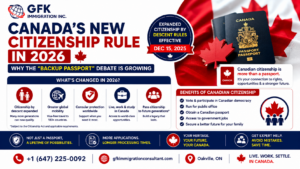
Many applicants are pursuing Canadian citizenship because of the benefits associated with holding a Canadian passport, including:
- Visa-free or visa-on-arrival access to numerous countries
- Greater international mobility
- Access to consular assistance abroad
- The ability to live, work, and study in Canada
- Eligibility to pass citizenship to future generations in qualifying circumstances
Critics argue that some applicants may have little intention of living in Canada and instead view citizenship primarily as a contingency plan or “backup passport.” Supporters, however, maintain that citizenship by descent recognizes legitimate family ties and preserves connections between Canadians and their descendants worldwide.
Increased Demand Is Creating Processing Pressures
The surge in citizenship applications has generated significant demand for proof-of-citizenship documentation and historical records.
Applicants claiming citizenship through ancestry often need to obtain:
- Birth certificates
- Naturalization records
- Marriage certificates
- Historical family records
- Citizenship certificates from previous generations
Reports indicate that archives and record repositories across Canada have experienced substantial increases in document requests since the new law came into force.
As a result, processing times for some citizenship-related requests have increased, and applicants should be prepared for additional waiting periods.
Canadian Citizenship Is More Than a Passport
Canadas New Citizenship Rule in 2026
While public discussions often focus on travel benefits, Canadian citizenship carries significant rights and responsibilities.
Canadian citizens may:
- Vote in federal, provincial, and municipal elections
- Run for public office
- Obtain a Canadian passport
- Access certain government positions
- Participate fully in Canada’s democratic system
Importantly, citizenship should not be viewed solely as a travel document.
The Government of Canada clearly states that proof of citizenship is not a passport and cannot be used as a substitute travel document. Canadian citizens travelling internationally generally require a valid Canadian passport to enter or return to Canada by air.
Who May Benefit From the New Rules?
The 2026 citizenship reforms may benefit several groups, including:
Descendants of Canadian Citizens
Individuals born outside Canada who previously fell outside the first-generation limit may now qualify for citizenship recognition.
Families Seeking Long-Term Mobility
Canadian citizenship can provide flexibility for future education, employment, and relocation opportunities.
Former “Lost Canadians”
Some individuals who were previously excluded from citizenship because of historical legislative gaps may now qualify under the updated rules.
What Does This Mean for Future Immigration Policy?
The expanded citizenship rules are likely to influence future discussions around:
- Citizenship eligibility
- Population growth
- Immigration planning
- Processing capacity
- Service delivery timelines
Canada continues to balance its commitment to family connections, constitutional principles, and long-term immigration objectives.
While some concerns remain regarding the concept of citizenship as a “backup option,” the current legislation reflects Parliament’s decision to broaden access for descendants of Canadian citizens worldwide.
Frequently Asked Questions
Can I become a Canadian citizen simply because I have a Canadian grandparent?
Canadas New Citizenship Rule in 2026
Possibly. Eligibility depends on your family’s citizenship history, dates of birth, residency requirements, and the specific provisions of the amended Citizenship Act. Professional assessment is recommended.
Does Canadian citizenship automatically give me a passport?
No. Citizenship and passports are separate processes. Eligible citizens must apply for a Canadian passport after obtaining proof of citizenship.
Can I keep my current citizenship?
Canada generally permits dual citizenship. However, applicants should also verify whether their current country of citizenship permits dual nationality.
Do I need to live in Canada to claim citizenship by descent?
Requirements vary depending on individual circumstances and the applicable provisions of the Citizenship Act. Legal eligibility should be assessed on a case-by-case basis.
How GFK Immigration Inc. Can Help
Determining citizenship eligibility through ancestry can be complex, particularly when multiple generations, historical records, and legislative changes are involved.
At GFK Immigration Inc., our experienced immigration professionals assist clients with:
- Citizenship eligibility assessments
- Proof of citizenship applications
- Citizenship certificate applications
- Permanent residence pathways
- Family sponsorship programs
- Express Entry applications
- Immigration compliance reviews
We help clients understand their options and navigate Canada’s evolving immigration and citizenship landscape with confidence.
Final Thoughts
Canada’s new citizenship rules in 2026 represent one of the most significant citizenship reforms in recent years.
By expanding citizenship-by-descent eligibility, Canada has opened new opportunities for families with Canadian roots around the world. At the same time, the changes have fueled debate about citizenship, identity, and the growing demand for Canadian passports.
Whether viewed as a reconnection with Canadian heritage or a pathway to greater global mobility, the reforms are reshaping how citizenship is understood and accessed in 2026.
For individuals who believe they may qualify, obtaining professional guidance can help clarify eligibility and ensure that applications are prepared correctly from the outset.
Need Help Determining Your Canadian Citizenship Eligibility?
GFK Immigration Inc.
📞 +1 (647) 225-0092
🌐 gfkimmigrationconsultant.com
📍 Oakville, Ontario, Canada
Disclaimer: This article is for informational purposes only and does not constitute legal advice. Citizenship laws and eligibility requirements may change. Always consult official government sources or a qualified immigration professional regarding your specific situation.