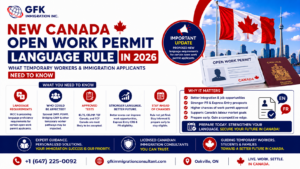
New Canada Open Work Permit Language Rule in 2026: What Temporary Workers and Immigration Applicants Need to Know
Canada may soon introduce one of the most significant changes to its open work permit system in recent years.
According to Immigration, Refugees and Citizenship Canada’s (IRCC) updated 2026 Forward Regulatory Plan, the federal government is now actively moving toward proposed regulations that could introduce mandatory language proficiency requirements for certain open work permit applicants.
While the rule has not yet officially taken effect, the proposal is now advancing through formal regulatory stages, making it a major development that temporary workers, international graduates, spouses, and future immigration applicants should monitor closely.
At GFK Immigration Inc., we are already helping clients prepare strategically for potential language-related immigration changes that could affect Canadian work permit eligibility and long-term permanent residence plans.
What Is Canada’s Proposed Open Work Permit Language Rule?
IRCC’s updated Forward Regulatory Plan confirms that Canada is considering amendments that may require certain open work permit applicants to demonstrate language proficiency through approved testing.
The proposal is currently in the regulatory development stage and is expected to be pre-published in the Canada Gazette in Spring or Summer 2026 for public consultation.
This means:
- The rule is not yet law
- Final eligibility requirements have not been officially announced
- Language score thresholds remain unconfirmed
- Specific affected permit categories are still under review
However, consultations with provinces, territories, and private-sector stakeholders have already been completed, indicating that the proposal is progressing seriously within IRCC’s policy framework.
Why Canada Is Considering Language Requirements for Open Work Permits
Canada’s immigration system is increasingly prioritizing:
- Labour market integration
- Economic outcomes
- Workforce productivity
- Long-term settlement success
- Permanent residence readiness
IRCC has repeatedly emphasized the importance of language ability in:
- Economic immigration
- Workforce participation
- Community integration
- Employment success
The proposed language rule appears aligned with Canada’s broader immigration strategy focused on selecting candidates who can integrate more effectively into the Canadian labour market.
Which Open Work Permits Could Be Affected?
At this stage, IRCC has not released a final list of affected work permit categories. However, immigration analysts believe potential changes could impact some applicants under:
- Spousal Open Work Permits (SOWP)
- Post-Graduation Work Permits (PGWP)
- Bridging Open Work Permits (BOWP)
- Temporary Resident to Permanent Resident (TR-to-PR) pathways
- Family-member open work permits
Current IRCC guidance already outlines eligibility conditions for several open work permit categories, including spouses of foreign workers and PR applicants.
The government has not confirmed whether all open work permits would require language testing or whether the rule would target only specific streams.
What Language Tests Could Canada Require?
Although IRCC has not officially confirmed approved tests for this proposal, Canada already accepts several language exams across immigration programs, including:
- IELTS General Training
- CELPIP
- TEF Canada
- TCF Canada
Most experts expect any future language requirement would likely use existing approved IRCC testing systems already used for:
- Express Entry
- Provincial Nominee Programs (PNPs)
- Canadian citizenship
- Permanent residence applications
Could Language Scores Affect Work Permit Approval?
Potentially, yes.
If implemented, language thresholds could become part of eligibility criteria for certain applicants seeking:
- Initial work permits
- Work permit renewals
- Family-member open work permits
- Transition permits tied to PR pathways
However, IRCC has not yet confirmed:
- Minimum required CLB scores
- Whether English or French proficiency would be mandatory
- Which occupations may be exempt
- Whether existing permit holders would be grandfathered under old rules
These details are expected to become clearer after the proposed regulations are officially published.
What This Means for International Students and PGWP Holders
International students planning to remain in Canada after graduation should pay close attention to these developments.
Canada continues to maintain Post-Graduation Work Permit eligibility stability for 2026, which provides some reassurance for students currently studying in Canada.
However, if language requirements eventually expand into open work permit categories, students with stronger English or French skills may gain a major advantage in:
- Work permit eligibility
- Express Entry competitiveness
- Permanent residence pathways
- Labour market access
For many applicants, language proficiency is no longer simply beneficial — it is becoming increasingly strategic.
Impact on Spousal Open Work Permits in 2026
Canada already introduced stricter eligibility changes for certain family-member open work permits beginning January 21, 2025.
Under current rules:
- Some low-skilled worker families face reduced eligibility
- PR pathway workers may still qualify
- Certain Strategic Immigration Program applicants remain eligible
If language rules are added in the future, spousal applicants may face additional screening requirements tied to:
- Language ability
- Occupation level
- Immigration pathway
- Economic integration factors
This could significantly affect temporary foreign workers planning family immigration strategies.
Why French Language Skills Could Become Even More Valuable
Canada’s immigration system continues prioritizing Francophone immigration in 2026 through:
- Category-based Express Entry draws
- Lower CRS cut-offs
- Francophone recruitment initiatives
- Additional immigration pathways
Applicants with strong French proficiency may remain particularly competitive if future language-based work permit policies are introduced.
At GFK Immigration Inc., we are seeing increasing demand for:
- TEF Canada preparation
- French-language immigration strategies
- Bilingual Express Entry optimization
What Applicants Should Do Right Now
Although the rule is still proposed and not finalized, proactive preparation is highly recommended.
Recommended Steps:
- Begin improving English or French skills
- Prepare for approved language testing early
- Maintain valid immigration status
- Monitor official IRCC announcements
- Avoid relying on unofficial social media rumours
- Review long-term PR strategies with licensed professionals
Applicants already planning for Express Entry or PNP pathways may benefit significantly from improving language scores now rather than waiting for future regulatory changes.
Expert Guidance from GFK Immigration Inc.
Canada’s immigration system is evolving rapidly in 2026, and work permit rules are becoming increasingly complex.
At GFK Immigration Inc., we help:
- International students
- Temporary foreign workers
- Families
- Skilled workers
- PR applicants
navigate Canada’s immigration system with confidence and clarity.
As licensed Canadian immigration professionals, we provide personalized guidance on:
- Open work permits
- Express Entry
- PR pathways
- CRS optimization
- Language strategy planning
- Spousal sponsorship
- Work permit extensions
Our goal is to help clients stay ahead of immigration changes before they affect eligibility.
Final Thoughts
Canada’s proposed open work permit language rule signals a major shift toward stronger economic and labour-market integration requirements.
Although the proposal is not yet finalized, the direction is becoming increasingly clear:
language proficiency is likely to play a larger role in Canada’s temporary and permanent immigration system moving forward.
For international students, temporary workers, spouses, and future PR applicants, preparing early could create a major competitive advantage.
As Canada continues refining its immigration policies in 2026, applicants who strengthen their language profiles now may be best positioned for long-term immigration success.
Need Help Preparing for Canada’s Immigration Changes?
Connect with GFK Immigration Inc. today for trusted immigration guidance tailored to your goals.
📞 +1 (647) 225-0092
🌐 GFK Immigration Inc.
📍 Oakville, Ontario, Canada
#CanadaImmigration #OpenWorkPermit #CanadaWorkPermit #ExpressEntry #IRCC #CanadaPR #StudyInCanada #WorkInCanada #TemporaryWorkersCanada #InternationalStudentsCanada #CanadianImmigration #CanadaVisa #ImmigrateToCanada #ExpressEntry2026 #CRSScore #PGWP #SpousalOpenWorkPermit #CanadaUpdates #FrenchLanguage #IELTSCanada #CELPIP #TEFCanada #PRPathway #CanadianPR #ImmigrationConsultant #GFKImmigration #MoveToCanada #CanadaJobs #LanguageRequirements #Canada2026