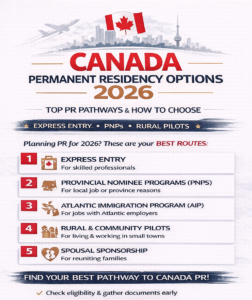
Canada Permanent Residency Options in 2026 — What to Know
Canada’s immigration landscape for 2026 is more targeted and tightly managed than in past years. Admissions targets, provincial priorities and new pilot streams mean that the right pathway for you depends on timing, job fit, and where you live or plan to work. This guide breaks the five most practical PR routes for 2026, what each looks like, and how to pick the best option for your situation.
Quick headline numbers you should know
The 2026–2028 Immigration Levels Plan sets Canada’s overall PR admissions target for 2026 at 380,000 (with operational ranges).
Here are the key program targets that shape the year:
- Express Entry (Federal High-Skilled): ~109,000 admissions (federal skilled streams).
- Provincial Nominee Programs (PNPs): ~91,500 admissions (province-driven nominations).Atlantic Immigration Program (AIP): ~4,000 admissions (designated-employer pathway).
- Rural & Community Pilots (RCIP + FCIP): ~8,175 admissions (community-based pilots).
- Spousal & Family Sponsorship: ~69,000 admissions (family reunification).
These targets are admissions (people becoming permanent residents), not invitations or nominations; they shape how provinces and IRCC manage draws and intakes all year.
1) Express Entry — the core skilled-worker route
Best for: Skilled professionals with strong language scores, validated education credentials, and Canadian work experience (or a qualifying job offer).
Why it still matters: Express Entry remains the main federal engine for economic PR — it’s open year-round, profiles sit in the pool, and IRCC issues invitations based on categories and scores. The 2026 admissions target for Federal High-Skilled pathways signals a continuing emphasis on skilled immigration.
What to prepare:
- Create or update your Express Entry profile.
- Book approved language tests and get ECA (education credential assessment).
- If you can, strengthen your CRS: Canadian work experience, a valid job offer, higher language bands, or a PNP nomination.
Timing & cost: IRCC often aims to process completed PR applications in ~6 months after an Invitation to Apply (ITA), though actual timing can vary with volume.
2) Provincial Nominee Programs (PNPs) — the practical “plan B”
Best for: Candidates with provincial ties (job offers, study, previous work) or in-demand skill sets matched to local labour needs.
Why consider PNPs: Provinces can nominate candidates even if their Express Entry score is lower — a PNP nomination typically adds 600 CRS points (effectively guaranteeing an ITA if aligned with Express Entry). PNPs are wide-ranging and often more predictable for certain occupations.
What to watch for in 2026:
- Provinces may open/close streams based on local caps and labour market needs.
- Expect higher wage or skill thresholds in some regions; prepare documentation of job offers, local ties, and recruitment efforts.
3) Atlantic Immigration Program (AIP) — employer-driven and practical
Best for: Skilled workers and international graduates who have job offers from designated employers in Atlantic Canada.
How it works: Designated employers hire, the employer and settlement services prepare a settlement plan, the province endorses, and then the candidate applies for PR with the endorsement. It’s a two-stage, employer-led route that can be faster for approved files.
Tip: Secure a job with a designated employer and document your settlement plan early; the employer’s endorsement is central to success.
4) Rural & Community Immigration Pilots (RCIP & FCIP)
Best for: Skilled applicants who are ready to live and work in participating rural or Francophone-minority communities.
Why they matter in 2026: These pilots are specifically funded to help smaller communities fill hard-to-staff roles — they remain open in 2026 but places are limited and community intake can close when caps are reached. If you have a community-based job offer, this can be one of the most direct PR routes.
Practical steps: Confirm the community’s open intake, secure a local job offer, and prepare the settlement-plan and evidence the community requires.
5) Spousal & Family Sponsorship — ongoing family reunification
Best for: Permanent residents or citizens sponsoring spouses, partners and dependent children.
Why it’s still a priority: Family reunification forms a major share of admissions and remains a standing pathway — sponsorship streams continue to be operational throughout 2026. Expect processing volume and timelines to move with IRCC operational priorities.
Which pathway fits you? A fast decision guide
- You have high CRS or Canadian work experience → Express Entry.
- You have a job offer or provincial ties → Target the PNP of that province.
- You have a job with a designated employer in Atlantic Canada → AIP.
- You’ll live in a small participating community → RCIP / FCIP.
- Your spouse or partner is a PR/citizen → Family sponsorship.
Actionable checklist — prepare now
- Audit eligibility: confirm language test windows, ECA timelines and any job-offer documents you’ll need.
- Gather core documents: passports, police certificates, education records, employment letters and pay stubs.
- Strengthen your profile: improve language scores, validate foreign credentials, secure an employer offer where possible.
- Map provincial rules: PNP requirements vary — check the province’s official streams and timelines before applying.
- Get expert help early: fast-changing quotas and intake windows mean timing and documentation matter — an RCIC can help you prioritize the best route.
FAQs (short & searchable)
Q: Are these pathways always open?
Most remain operational year-round, but provinces can pause streams or hit quotas — readiness matters.
Q: Does a PNP nomination speed up PR?
Yes — many PNP nominations are aligned with Express Entry and effectively guarantee an ITA by adding 600 CRS points.
Q: How long will PR processing take?
Processing varies by pathway and volume; Express Entry applications often show faster turnaround (~6 months after ITA), while PNPs and employer-driven routes can take longer depending on provincial and federal processing.
Final takeaway
2026 will reward candidates who plan deliberately: target the pathway that matches your job, location and documentation readiness. Express Entry and PNPs remain the main gateways for skilled workers, while employer-driven and community pilots offer strong alternatives for targeted cases.
If you’d like a tailored review — profile audit, pathway recommendation, or help assembling documents — book a consultation with an RCIC today to build a strategy that reflects the 2026 targets and local rules.
Contact GFK Immigration
Gboyega Esan — RCIC R708591
📞 +1 (647) 225-0092
✉️ gfkimmigrationconsultant@gmail.com
🌐 gfkimmigrationconsultant.com
Sources: Official program targets and pathway summaries (2026–2028 Immigration Levels Plan and IRCC program pages).