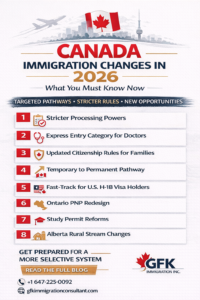
Canada Immigration Changes in 2026 — What You Must Know Now
As Canada heads into 2026, its immigration system is undergoing some of the biggest policy shifts seen in years. These changes are designed to strengthen system integrity, target specific labour needs, and shape the future of temporary and permanent immigration in strategic ways. Whether you’re planning to work, study, or settle in Canada, understanding these updates early gives you a major advantage.
Below is a clear, practical breakdown of the top immigration changes expected in 2026, how they work, and what they mean for your application strategy.
1. Stronger Processing Control Powers (Bill C-12)
One of the most impactful changes tied to 2026 isn’t about eligibility — it’s about how the immigration system handles your file.
Bill C-12 — officially known as the Strengthening Canada’s Immigration System and Borders Act — gives Immigration, Refugees and Citizenship Canada (IRCC) stronger authority to pause, suspend, or cancel applications already under review in certain circumstances. This move is framed as a way to protect the integrity of the system, but it also means being “in process” doesn’t always guarantee a straight path to approval.
Why it matters: Applicants should be extra careful with documentation and legal compliance, because enforcement will be more rigorous under this new authority.
2. New Express Entry Category for Doctors
Canada continues to refine its Express Entry system with targeted pathways for occupations in high demand.
A dedicated selection category for doctors is being introduced for 2026, aimed at practitioners who already have at least 12 months of recent Canadian work experience. This category will be separate from the traditional points-based pool, designed to speed up invitations for medical professionals — a critical step as Canada works to address healthcare staffing shortages.
Who benefits most: Physicians, surgeons, clinical specialists and laboratory medicine professionals already employed in Canada under valid work authorization.
3. Revised Citizenship Rules for Families
Canada’s citizenship framework is being updated for 2026 in ways that could affect globally mobile families.
Under the new rules, citizenship by descent will no longer automatically apply to the first generation born abroad. Instead, citizenship transmission will depend on a “substantial connection” — defined by physical presence in Canada before the child’s birth or adoption.
What this means: Families with children born outside Canada need to understand and plan for the new connection requirements if they hope to preserve citizenship rights for future generations.
4. Temporary Resident to Permanent Resident Pathway (2026–2027)
To support long-term settlement and labour market needs, Canada is planning a new Temporary Resident to Permanent Resident (TR-to-PR) pathway across 2026 and 2027.
This initiative is expected to allow up to 33,000 temporary workers currently in Canada to transition to permanent residence — especially those with strong community ties and established employment.
Key focus: Applicants already in Canada with work experience, especially in in-demand occupations and regions.
5. Targeted Pathway for U.S. H-1B Visa Holders
Canada is also advancing a fast-track immigration pathway for holders of the U.S. H-1B visa. This pathway is designed to accelerate permanent residency for highly skilled professionals already operating in a Canadian-aligned labour market, offering a more predictable route compared to traditional Express Entry timelines.
Why it’s significant: This change reflects Canada’s strategy to attract and retain top global talent in a competitive labour environment.
6. Proposed Ontario PNP Redesign
Ontario is consulting on a major redesign of the Ontario Immigrant Nominee Program (OINP) for 2026. The proposed structure could:
- Consolidate Employer Job Offer streams into TEER-based tracks
- Introduce healthcare and entrepreneur focused pathways
- Prioritize targeted invitations by region and skill category
These reforms are still under consultation, but they signal a shift toward more specialized provincial nomination pathways.
7. New Study Permit Rules
International student policy will also shift in 2026 with updated study permit rules. Some key features include:
- Exemptions from Provincial Attestation Letter (PAL) or Territorial Attestation Letter (TAL) for specific graduate-level applicants beginning January 1, 2026
- Provincial allocations and differentiated treatment based on applicant type and institution
What this means: Study permit pathways are becoming more structured, with certain exemptions for graduates from designated programs.
8. Alberta Rural Renewal Stream Redesign
Starting January 1, 2026, Alberta will implement changes to its Rural Renewal Stream, altering eligibility, endorsement criteria and assessment requirements to better align with local economic priorities.
What This All Means for You in 2026
Canada’s immigration system in 2026 will be:
🔹 More Targeted
New categories and pathways focus on specific skills (like healthcare and H-1B holders) and community-rooted applicants.
🔹 More Strategic
Plans like the TR-to-PR pathway aim to convert existing temporary residents into permanent Canadians more efficiently.
🔹 More Controlled
Bill C-12 and updated processing rules reflect a shift toward careful system management rather than broad mass intake.
How to Prepare
To navigate these changes successfully:
- Update your Express Entry profile to reflect targeted categories
- Gather all documentation early and review legal compliance
- Consult a licensed Canadian immigration professional to refine your strategy
- Plan long-term if you’re currently on a study or work permit
Conclusion
Canada’s 2026 immigration environment is shaping up to be more structured and more strategic — providing opportunity for those who plan carefully while strengthening system integrity. If your journey to Canada involves permanent residence, work, or study, now is the time to update your strategy with a seasoned expert at your side
#CanadaImmigration2026 #IRCCUpdates #ExpressEntry #StudyPermitCanada #PNP #WorkInCanada #GFKImmigration #ImmigrationConsultant.