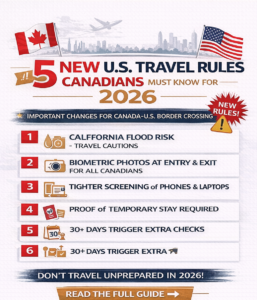
5 New U.S. Travel Rules Canadians Must Know for 2026 — Quick Guide
Travel to the United States in 2026 looks different from what many Canadians expect. Several rule changes introduced in late 2025 are now rolling into everyday border practice — most notably an expanded biometric photo collection requirement that took effect December 26, 2025. These changes affect land, air and sea crossings, and they increase the need for careful pre-trip planning. Below is a practical, traveller-friendly breakdown of the five rules Canadians should know, what they mean in real terms, and exactly what to do before you go.
Quick snapshot — the five rules at a glance
- California flood risks: severe weather and landslides may disrupt travel.
- Biometric photos at entry and exit: expanded facial photo collection is now in effect at many ports.
- Tighter screening — including devices: expect requests to inspect phones and laptops.
- Proof of temporary travel: officers may ask you to prove ties, funds and a clear return plan.
- 30-day trigger for extra compliance: stays longer than 30 days can require additional registration or biometrics.
1) California flooding — practical travel risk
Southern California experienced unusually heavy rains and flash flooding in late December 2025; the Canadian government updated travel advice after several counties were placed under state of emergency. If your route runs through affected counties (Los Angeles, Orange, Riverside, San Bernardino, San Diego, Shasta) expect road closures, service disruptions and possible evacuations — and build flexibility into every leg of your trip.
Before you go: monitor local emergency alerts, avoid travel into flood zones, and keep backup accommodation and route plans ready.
2) Biometric photos on entry and exit — yes, even for children
A Department of Homeland Security final rule published in October 2025 expanded authority for facial-biometric collection of non-U.S. citizens at entry and exit; the rule became effective December 26, 2025. In practice this means many travellers — including children who might previously have been exempt — can be photographed at airports, land border crossings and seaports.
How this affects families: prepare children for brief stops and photos, keep passports handy, and allow extra time at crossings (especially busy land ports).
3) Device checks are more common — prepare your phone and laptop
U.S. border officers have authority to examine electronic devices and may request access; device inspections can lead to longer secondary interviews, missed connections or even seizure in refusal cases. The best practical steps are simple: keep devices charged, place them in airplane mode if suggested by travel guidance, minimize sensitive on-device content you don’t need for the trip, and consider a clean “travel” device if you regularly carry a lot of personal data.
On the spot: if asked to unlock a device, remain calm and factual — refusal can cause delay or other consequences.
4) Be ready to prove your trip is temporary and legitimate
Expect routine but sometimes detailed questioning about your travel purpose, accommodation, funds and ties to Canada. Officers increasingly ask for proof of employment or study, a return itinerary, and a local stay address. Simple omissions — like one-way tickets or vague answers — commonly cause secondary checks. Carry printed or easily accessible digital copies of:
- employer or school letters,
- recent pay stubs or enrollment confirmation,
- return travel bookings or driving itinerary,
- hotel reservation or host address with phone number, and
- a recent bank statement or credit availability note.
5) Extended stays over 30 days: plan for extra steps
U.S. guidance and implementation documents indicate that stays beyond about 30 days can trigger additional registration or biometric obligations for certain classes of non-citizens. Snowbird-style long stays, extended family visits and remote-work travel may require extra compliance checks — and these rules are being enforced more visibly in 2026. Treat “over 30 days” as a planning red flag: check USCIS guidance and, if necessary, confirm registration requirements well before you leave.
Practical pre-departure checklist (simple and effective)
- Carry a reliable return plan and contact details for your U.S. accommodation.
- Pack proof of ties to Canada (employment letter, lease, school docs).
- Keep devices charged, accessible, and remove unnecessary sensitive data; consider a spare travel phone.
- Prepare children and seniors for biometric photos — and extra screening time.
- If your stay could exceed 30 days, confirm any registration or biometric requirements ahead of time.
Top FAQs Canadians ask about 2026 travel
Do children still need photos?
Yes — the expanded biometric rule removes many previous age-based exemptions, so families should expect photo collection for younger travellers.
Can U.S. officials search my phone?
Yes; U.S. border agents can request device access. If you refuse, you may face delays, device seizure, or denied entry in serious cases. Prepare and stay calm.
What if my trip is longer than 30 days?
Treat that duration as a compliance trigger — check USCIS and CBP guidance and keep detailed records of your entry date and plans.
Final takeaway — prepare, don’t panic
The border is more consistent and data-driven in 2026: photos, device checks and clearer compliance thresholds are here to stay. For most travellers the fix is straightforward — better documents, realistic plans, and a calm approach at the border will prevent most problems. If you travel frequently, plan extended stays carefully and consider using a travel-only device or holding minimal sensitive content on your phone.
Need help planning a U.S. trip in 2026?
If you want a quick pre-trip checklist review or help assembling documentation for family travel, GFK Immigration Inc. can help you prepare.
Contact RCIC Gboyega Esan (R708591) for a focused consultation:
Phone: +1 (647) 225-0092
Email: gfkimmigrationconsultant@gmail.com
#CanadaToUS #TravelRules2026 #CrossBorderTravel #ImmigrationAdvice #GFKImmigration #TravelSmart