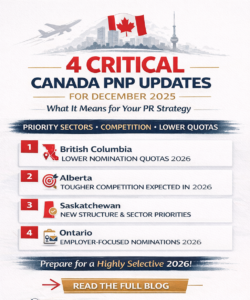
4 Critical Canada PNP Updates for December 2025 — What It Means for Your PR Strategy
Canada’s provincial immigration landscape is shifting fast. As we close out 2025, several Provincial Nominee Programs (PNPs) have released key updates that will shape how candidates can secure permanent residence — especially heading into 2026. These changes affect nomination allocations, eligibility criteria, and competition levels across major provinces.
Understanding these updates now will give you a strategic edge when planning your immigration path. Below is a breakdown of the four most important PNP developments from December.
1. British Columbia PNP — Reduced Nominations for 2026
British Columbia confirmed that its 2026 PNP allocation has been set at just 5,254 nominations — significantly lower than the province’s request of 9,000 slots.
That lower allocation means:
- Fewer invitations across all BC PNP streams
- Increased competition for nomination slots
- Priority given to candidates with high economic impact (senior professionals or high-earning roles)
In fact, BC has already fully used its 2025 PNP allocation after federal top-ups, and is now reassessing how best to deploy its limited 2026 spaces.
What this means for you
If you’re targeting BC for PR, expect:
- higher thresholds
- more competition
- a need for strong job offers and high-value profiles
2. Alberta PNP — 2025 Fully Allocated, High Competition Ahead
Alberta’s nomination quota for 2025 is now fully exhausted. The province began the year with 4,875 allocations, received an additional 1,728 spots, and ultimately issued about 6,750 nominations after federal adjustments.
Alberta draws highlights (2025):
- Alberta Opportunity Stream: 3,712 nominations
- Rural Renewal: 1,040
- Dedicated Healthcare Pathways: 563
- Tech and priority sector pathways: 1,118 combined
What to expect in 2026
As of late December:
- Thousands of Expressions of Interest (EOIs) are still in the pool
- No new Alberta nominations are expected until 2026
This underlines how competitive Alberta’s PNP has become, especially for employer-driven and non-priority occupation candidates.
3. Saskatchewan PNP — New Structure & Sector Priorities
Saskatchewan’s 2026 allocation is stable at 4,761 nomination spaces, but the way names will be selected is changing significantly.
Key shifts
- 50% of nominations reserved for priority sectors
- Healthcare
- Agriculture
- Skilled Trades
- Mining
- Manufacturing
- Energy
- Technology
- Capped sectors (like accommodation, trucking, and retail) will receive smaller portions and have specific intake windows.
Eligibility tightening
Starting in 2026:
- Only graduates from Saskatchewan-based institutions working in the province can use the Student category
- Many PGWP holders outside Saskatchewan will have limited pathways
- Open work permits including some spousal work permits may no longer qualify in certain streams
What this means
Saskatchewan is prioritizing:
- local labour market needs
- targeted economic sectors
- applicants with strong job alignment and residency ties
4. Ontario PNP — Full 2025 Allocation Reached With Employer Focus
On December 17, Ontario announced it had issued its full 10,750 nomination allocation for 2025 and will now count any further decisions toward its 2026 quota.
Breakdown of Ontario’s 2025 streams
- Employer Job Offer — Foreign Worker: 4,860 invitations
- Employer Job Offer — International Student: 6,605 invitations
- Employer Job Offer — In-Demand Skills: 1,063 invitations
- Masters/PhD Graduate streams: 0
- Entrepreneur: 0
Ontario’s 2025 outcomes highlight a strong tilt toward employer-supported pathways and a decreasing role for graduate or entrepreneurial streams.
What These PNP Changes Mean for You in 2026
Across Canada, the theme is consistent:
- Lower nomination allocations
- Greater competition
- More targeted, sector-specific priorities
- Higher thresholds for job offers and economic impact
This means general, open paths are becoming rarer, while employer-driven, high-value, and priority-sector applications will have the best chance of success in 2026.
Smart planning will be essential for:
- International graduates
- Skilled workers
- Employer-supported applicants
- Those in high-demand sectors
Quick Takeaways
- PNP nomination allocations are tighter heading into 2026.
- Provinces are prioritizing priority sectors and high-impact candidates.
- Saskatchewan and Alberta are reshaping eligibility and intake windows.
- Ontario continues to favour employer-linked nominations.
- Competition is intensifying — strategic, province-tailored applications matter now more than ever.
PNP Overview (FAQ Style)
What is the difference between a PNP and Express Entry?
A PNP is selected by a province based on local economic needs, while Express Entry is a federal ranking system for economic immigration. A PNP nomination adds 600 CRS points, significantly improving your chances of receiving a PR invitation.
Do I need a job offer?
In many cases yes, especially for employer-driven streams. Some provincial streams focus on education, work experience, or ties to the region, but requirements vary widely by province and stream.
How long does the PNP process take?
Processing times vary, particularly if aligned with Express Entry, which tends to be faster — but timelines depend on volume and provincial policies.
Final Thoughts
December’s PNP updates signal a new era for Canada’s provincial immigration programs. With allocations tightening and selection criteria becoming more focused, candidates should approach their 2026 immigration plans with strong research, careful stream selection, and — if possible — employer support.
Need expert guidance on the best provincial pathway for you? Consider booking a consultation with a licensed Canadian immigration consultant to build a targeted strategy that aligns with your profile and goals.
Gboyega Esan — RCIC R708591
 +1 (647) 225-0092
 gfkimmigrationconsultant@gmail.com
 gfkimmigrationconsultant.com